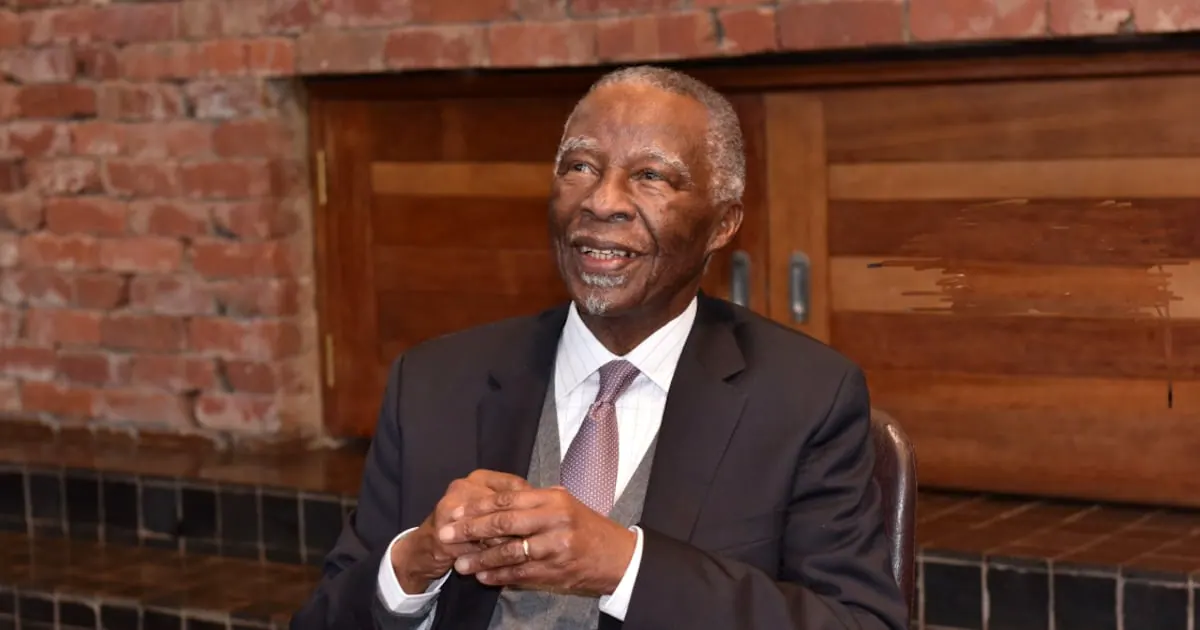
Former South African President Thabo Mbeki has published a 123-page essay through his foundation, accusing an organized group of mainly Afrikaner former operatives in the apartheid security establishment of a "counter-revolution" aimed at defeating and destroying the African National Congress (ANC). Mbeki's essay claims that this counter-revolution interfered with the ANC's 2007 national electoral congress to ensure that the leadership elected was to its liking, resulting in Jacob Zuma's rise to power.
Mbeki's argument is based on the perceived decline of South Africa's progress since the end of his presidency. He claims that the country had been on a virtuous growth path under his leadership and that of Nelson Mandela, but that this trajectory was disrupted under Zuma and Cyril Ramaphosa, with rising unemployment, poor growth, and increased corruption. Mbeki specifically points to the ANC's 2007 national electoral congress, where he lost the leadership to Zuma, as a turning point.
The counter-revolution, according to Mbeki, is composed of former apartheid intelligence operatives who infiltrated the ANC and manipulated the 2007 leadership election to install a leadership of their choice. He also accuses the counter-revolution of fueling violence against immigrants, damaging ANC relations with the rest of Africa, and contributing to a climate of despair in the country. Mbeki's claims have sparked significant interest and debate in South Africa.
Mbeki's essay has been met with skepticism by some, who view it as a self-serving attempt to deflect criticism of his own presidency. Critics point out that Mbeki's decision to run for a third term as ANC leader in 2007, which he lost to Zuma, may have contributed to his eventual ousting. Additionally, Mbeki's handling of issues such as HIV/AIDS and the R30 billion arms deal during his presidency have been widely criticized.
The publication of Mbeki's essay coincides with a recent event in Washington, where former AfriForum deputy leader Ernst Roets and others planted 3,000 crosses commemorating murdered farmers. Mbeki's essay appears to respond to this event, as well as other perceived threats to the ANC and its agenda. His claims have sparked a renewed debate about the role of Afrikaners in South African politics and society.
Mbeki's accusations have been described as an "astonishing document" that brims with rage, but also as a conspiracy theory. Some have questioned whether Mbeki's claims will gain traction, given his age and the controversies surrounding his presidency. At 84 years old, Mbeki's latest assertions may not have a significant impact on the country's politics.
The reaction to Mbeki's essay is likely to be closely watched, given the ongoing debates about South Africa's past, present, and future. As the country continues to grapple with challenges such as unemployment, corruption, and social inequality, Mbeki's claims may resonate with some, but others may view them as a distraction from the pressing issues facing the nation.
Key points
- Mbeki accuses Afrikaner 'counter-revolution' of sabotaging ANC and South Africa's progress.
- Essay claims counter-revolution interfered with ANC's 2007 leadership election.
- Mbeki's assertions have sparked skepticism and debate in South Africa.