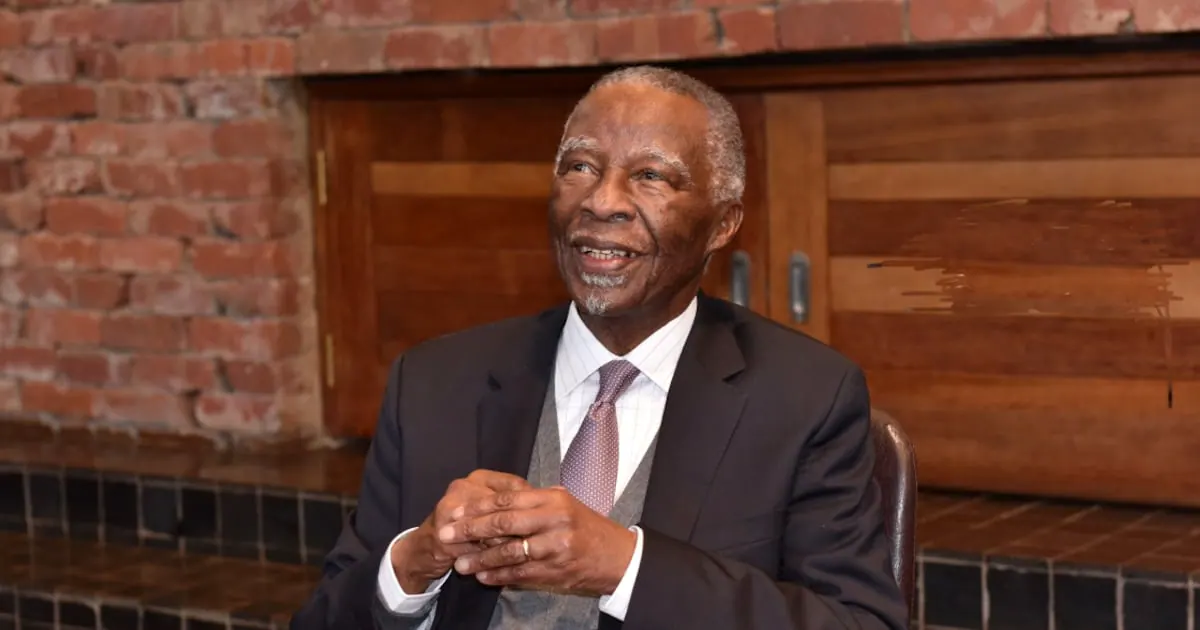
Former South African President Thabo Mbeki has published a 122-page essay through his foundation, accusing Afrikaner former operatives in the apartheid security establishment of infiltrating and influencing the country's politics. The essay, which has garnered significant attention, claims that these operatives, whom Mbeki refers to as a "counter-revolution," have been working to undermine the African National Congress (ANC) and its policies. Mbeki's assertions have sparked debate and concern among South Africans.
Mbeki's essay points to the ANC's 2007 national electoral congress as a pivotal moment when the "counter-revolution" took hold. He claims that the operatives, originally infiltrated into the ANC by the apartheid intelligence services, intervened in the congress to ensure that the leadership elected was to their liking, ultimately leading to Jacob Zuma's rise to power. Mbeki's account suggests that this intervention had far-reaching consequences, including the country's economic woes and high unemployment rates under Zuma and Cyril Ramaphosa's presidencies.
The former president specifically identifies Afrikaner organisations, such as the Solidarity Movement, as occupying spaces created by the "counter-revolution." He argues that these organisations have contributed to the country's climate of despair and damaged the ANC's relations with the rest of Africa. Mbeki also blames the "counter-revolution" for violence against immigrants. His essay has been described as self-serving, given his own role in shaping the country's politics during his presidency.
Mbeki's assertions have been met with skepticism by some, who view his claims as a conspiracy theory. Critics argue that Mbeki's essay deflects attention from his own leadership challenges and controversies, including his handling of HIV/AIDS and the R30 billion arms deal. At 84 years old, Mbeki's latest assertions have sparked debate about the role of apartheid-era operatives in contemporary South African politics.
The essay's release coincides with recent events in Washington, where AfriForum and other groups planted 3,000 crosses commemorating murdered farmers. Mbeki's claims have raised questions about the influence of Afrikaner groups on South African politics and their alleged connections to apartheid-era operatives. The issue has sparked concerns about the country's progress since the end of apartheid and the ongoing impact of historical divisions.
Mbeki's leadership during his presidency was marked by significant achievements, including a budget surplus in his final year in office. However, his legacy is also marred by controversy, particularly surrounding his handling of HIV/AIDS and the arms deal. His latest assertions have added to the complex narrative of his presidency and the ongoing challenges facing South Africa.
The impact of Mbeki's essay on the country's politics and public discourse remains to be seen. As South Africa continues to grapple with issues of inequality, unemployment, and corruption, the debate sparked by Mbeki's claims is likely to endure. The country's ongoing efforts to address its complex history and promote national unity will likely be influenced by this latest development in the country's ongoing conversation about its past and present.
Key points
- Mbeki claims Afrikaner former operatives in the apartheid security establishment are still influencing South African politics.
- The essay points to the ANC's 2007 national electoral congress as a pivotal moment when the "counter-revolution" took hold.
- Mbeki's assertions have been met with skepticism by some, who view his claims as a conspiracy theory.