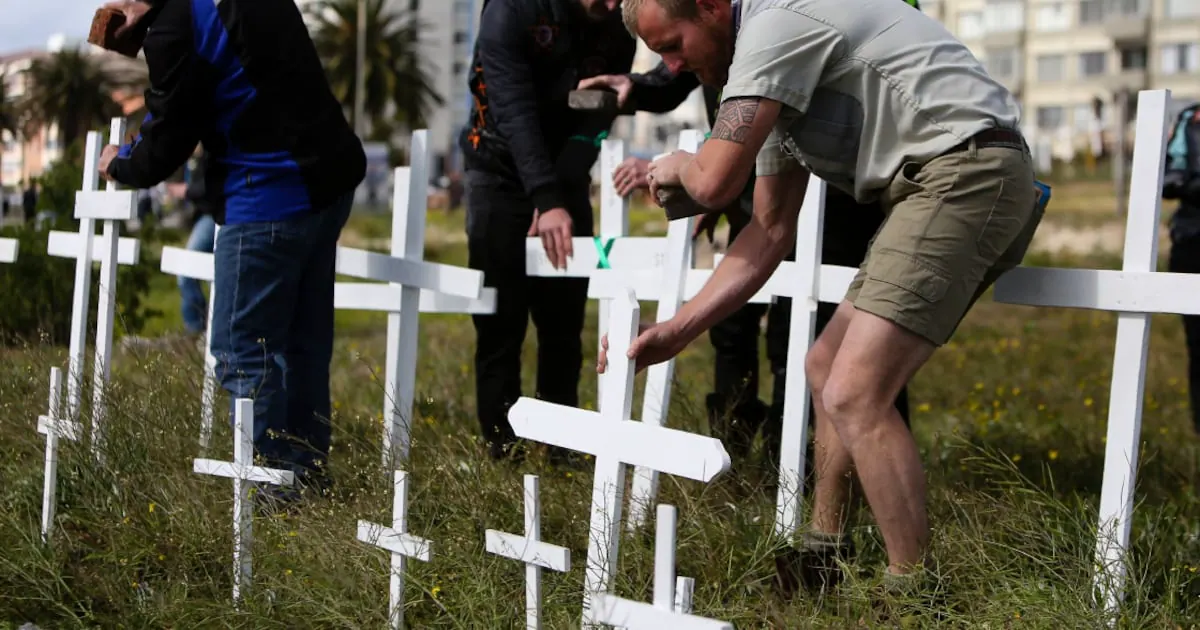
A heated debate has erupted in South Africa, sparked by the recent actions of Fikile Mbalula, the ANC's secretary-general, and Ernst Roets, former deputy CEO of AfriForum. Mbalula posted white crosses with names of victims of the apartheid regime, including anti-apartheid struggle heroes such as Matthew Goniwe and Chris Hani. This move was seen as a response to Roets's recent documentary and the planting of white crosses in Washington, DC, symbolizing alleged persecution of Afrikaners in South Africa.
Roets's documentary, released through his platform Lex Libertas, explores the condition of Afrikaners today, while the white crosses in Washington, DC, were meant to represent killings of white Afrikaner farmers. The stunt was likely to resonate with US conservatives and supporters of President Donald Trump's Make America Great Again (MAGA) movement. This spectacle coincided with new travel restrictions on South Africans by the US government, which expressed its displeasure at a confidential letter supposedly sent by President Cyril Ramaphosa.
The US government's travel restrictions were in response to demands made by the US, including a "stop to the murders of Afrikaner farmers" and the incitement of violence against the group. The latter was described in softer language, compared to a supposed genocide of Afrikaners. Mbalula's post, which included names of high-profile anti-apartheid struggle heroes on the crosses, was seen as a counter-narrative to Roets's gimmicks.
However, the actions of both Mbalula and Roets have been criticized for being unhelpful and trivializing an important topic in an already divided society. The struggle against apartheid was a war, and acknowledging the suffering of one side hardly helps the reconciliation project, which remains fragile. A group calling itself Afrikaners for SA has distanced itself from Roets's white crosses project, advocating for a more nuanced take on the scourge of crime.
Crime is a problem facing all South Africans, regardless of race, religion, or creed. Recent statistics show that all 28 victims of mass shootings at the weekend were black, as were the 11 women found dead in Ekurhuleni in the past fortnight. All South Africans deserve justice, and survivors of crime need support from the state and non-state actors.
The Thabo and Zanele Mbeki Foundation has released a monograph about the US, Afrikaners, and South Africa's future, offering a thoughtful intervention to pressing matters facing the country. The monograph aims to provide answers to the question of "how a society divided by conquest, racial domination, and economic exclusion can become a nation founded on common citizenship and meaningful equality".
As South Africa continues to grapple with its troubled past and present, it is clear that scapegoating and racial nationalism will not provide solutions. The country needs a more nuanced and inclusive approach to addressing its challenges, one that acknowledges the experiences of all its citizens. By working together, South Africans can build a more equitable and just society for all.
Key points
- The ANC and AfriForum have engaged in a symbolic battle over white crosses, highlighting the ongoing racial tensions in South Africa.
- The country's reconciliation project remains fragile, and such actions can set back the cause of building a new, inclusive society.
- Crime is a pressing issue affecting all South Africans, and a more nuanced approach is needed to address the problem.