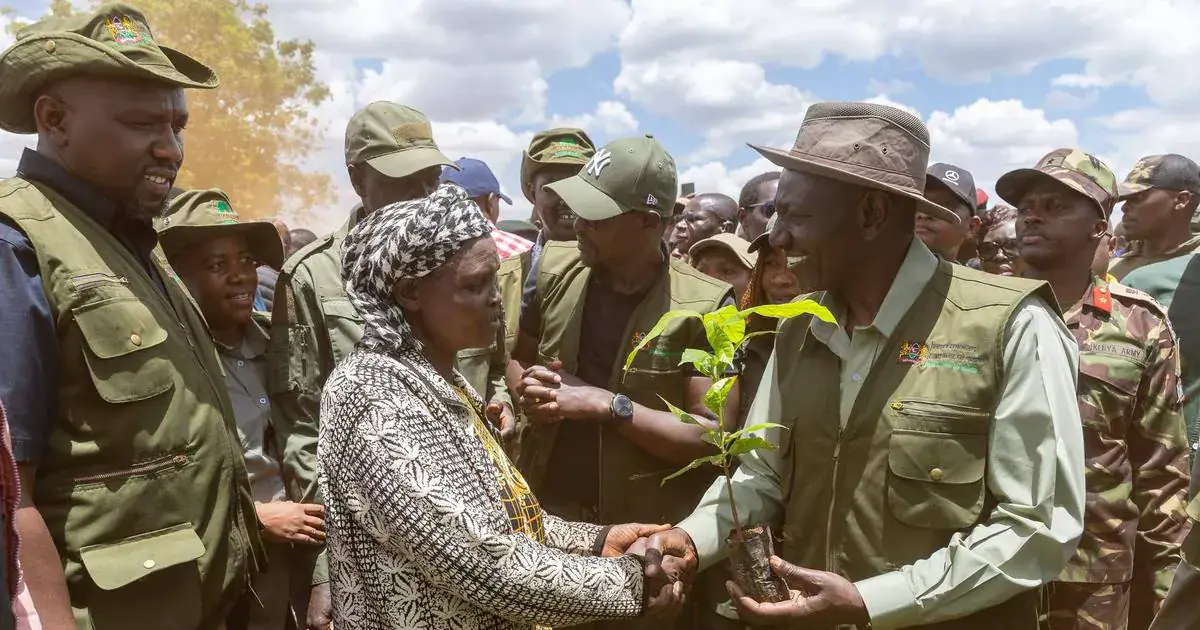
Kenya marked National Mazingira Day on October 10 with a nationwide tree-growing campaign, culminating in Trans Nzoia County. The government targeted 17.24 million trees during Mazingira Week, which ran from October 5 to 10, as part of its wider 15 Billion Tree Growing Initiative. This initiative aims to increase national tree cover from a baseline of 12.13 per cent to 30 per cent by 2032.
The 15 Billion Tree Growing Initiative also targets the restoration of 10.6 million hectares of degraded landscapes and ecosystems. The programme covers forests, water catchments, rangelands, wetlands, farms and urban areas, not just conventional tree plantations. Environment Cabinet Secretary Deborah Barasa said the country had planted approximately 2.2 billion trees towards the national target.
Tree cover helps regulate local temperatures, protect soils, reduce erosion and support water systems. Forests and other wooded landscapes also store carbon and provide habitats for wildlife, while trees on farms can improve soil conditions and provide farmers with fruit, timber and other products. Kenya's restoration strategy places particular emphasis on degraded drylands and arid and semi-arid areas.
The government has therefore framed the programme around several interventions, including forest rehabilitation, agroforestry, restoration of riparian zones and mangroves, commercial tree growing and sustainable land management. Planting trees in a dryland, however, requires a different approach from restoring a highland forest. Species must suit local rainfall, soils and ecological conditions.
A planted seedling does not automatically become a mature tree. Drought, grazing, fire, poor planting methods and unsuitable species can all reduce survival. Kenya Forestry Research Institute has been developing tools to help growers select species suited to different ecological zones, with the aim of improving survival rates.
The government's JazaMiti digital platform is intended to record and track tree-growing activities, including locations and participation. Such records can help identify where planting is taking place, but reliable long-term assessments also need to establish how many trees survive and whether degraded ecosystems are recovering.
Tree cover is not the same as forest cover. The two measurements are related but different. Tree cover measures the area covered by tree canopies across the landscape, including trees outside formally recognised forests. Forest cover refers to land classified as forest under the applicable assessment criteria.
Key points
- The Kenyan government aims to plant 15 billion trees by 2032 to raise tree cover to 30 per cent.
- The initiative targets restoration of 10.6 million hectares of degraded landscapes and ecosystems.
- Success depends on more than national planting days, requiring suitable seedlings, reliable water, protection from fires and grazing, community participation and sustained care.