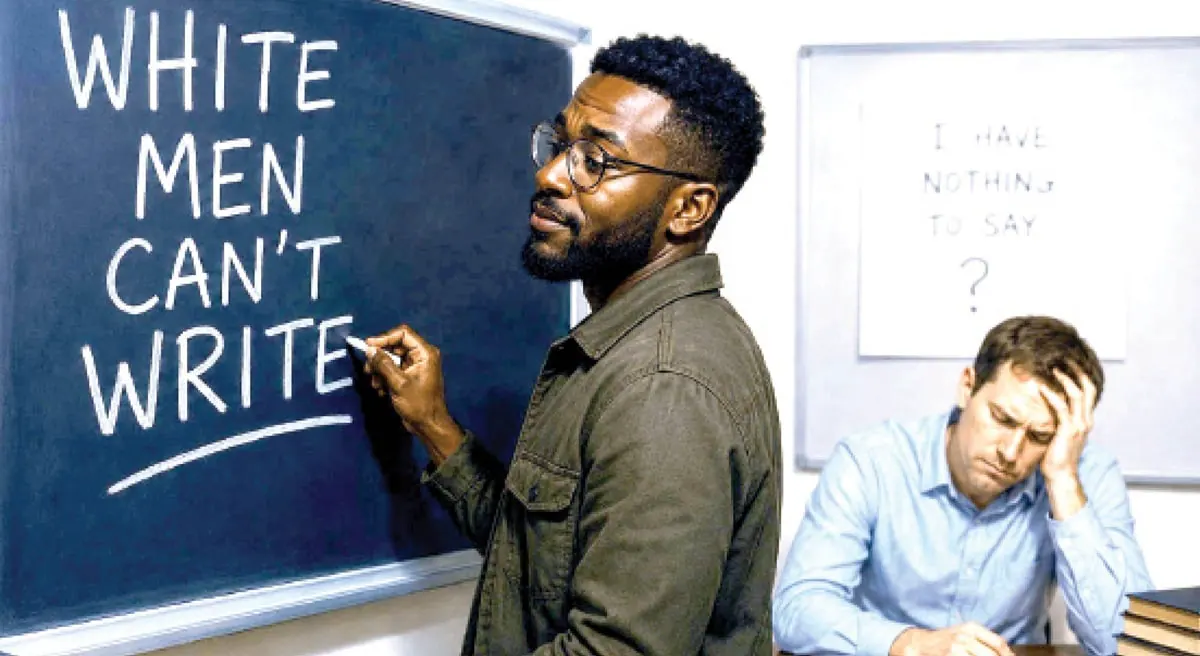
Maxim Uzoatu's short story 'White Men Can't Write' is a satirical parable that critiques corruption, neo-colonialism, mass psychology, media repression, and the seduction of miracle wealth. The story is set in the fictional town of Kita, where a mysterious and wealthy individual named Chan Dum has built a fortress. Chan Dum's wealth is so vast that it defies comprehension, and he uses it to manipulate the local population. According to Enam Obiosio of the Nigerian Tribune, Uzoatu's story is a political fable disguised as absurdist comedy.
The story's protagonist, Chan Dum, is a mythical figure manufactured by society. His name sounds vaguely Chinese, suggesting global capitalism and international commerce. Chan Dum's declaration that "White men can't write" is an obvious absurdity, but it serves as a nationalist mythology to conceal his criminal enterprise. This narrative device allows Uzoatu to explore how African elites manipulate memories of colonialism to shield themselves from accountability. By inverting colonial discourse, Uzoatu sheds light on the complexities of power dynamics.
The fortress in the story operates as a metaphor for the structure of oppression that the people of Kita collectively construct. They surrender their land and labor to build the fortress, only to realize that it is impregnable to both outsiders and themselves. This irony highlights George Orwell's insight that authoritarian systems survive not merely through force but through public participation. The people of Kita become architects of their own exclusion, illustrating the devastating consequences of their actions.
Pita the Pressman represents the moral centre of the story, embodying journalism as a voice of empirical reality. He strips away the mythology surrounding Chan Dum with a single sentence, revealing the truth about the toxic waste being transported to Africa. Chan Dum's response, labeling Pita "fake news," compresses an entire modern political vocabulary, highlighting the weaponization of truth and the neutralization of evidence through branding.
The crowd in the story occupies a morally uncomfortable territory between gullibility and complicity. They cheer, praise, and labor without questioning, only fleeing when the toxic waste appears. The ending denies readers emotional satisfaction, as there is no heroic uprising or poetic punishment for Chan Dum. Instead, reality sets in, and the people face the consequences of their own credulity. This narrative choice underscores the complexity of human nature.
Uzoatu's writing style echoes Igbo narrative traditions while embracing magical realism. His prose shifts effortlessly between proverb, political rhetoric, folklore, journalism, and grotesque comedy, resulting in a unique and captivating narrative voice. While the symbolism occasionally becomes transparent, this is a relatively minor criticism in a work that consciously adopts the performative excesses of oral satire.
Ultimately, 'White Men Can't Write' is not about race or writing but about narrative itself, specifically who controls it, who believes it, and who profits from it. Chan Dum's greatest fortune is made by writing a story that an entire community chooses to believe. The final image of the container holding no promised prosperity encapsulates the moral architecture of the tale, leaving readers to ponder the implications of Uzoatu's thought-provoking satire.
Key points
- Uzoatu's story critiques the manipulation of truth and the dangers of self-deception in the face of spectacular wealth and power.