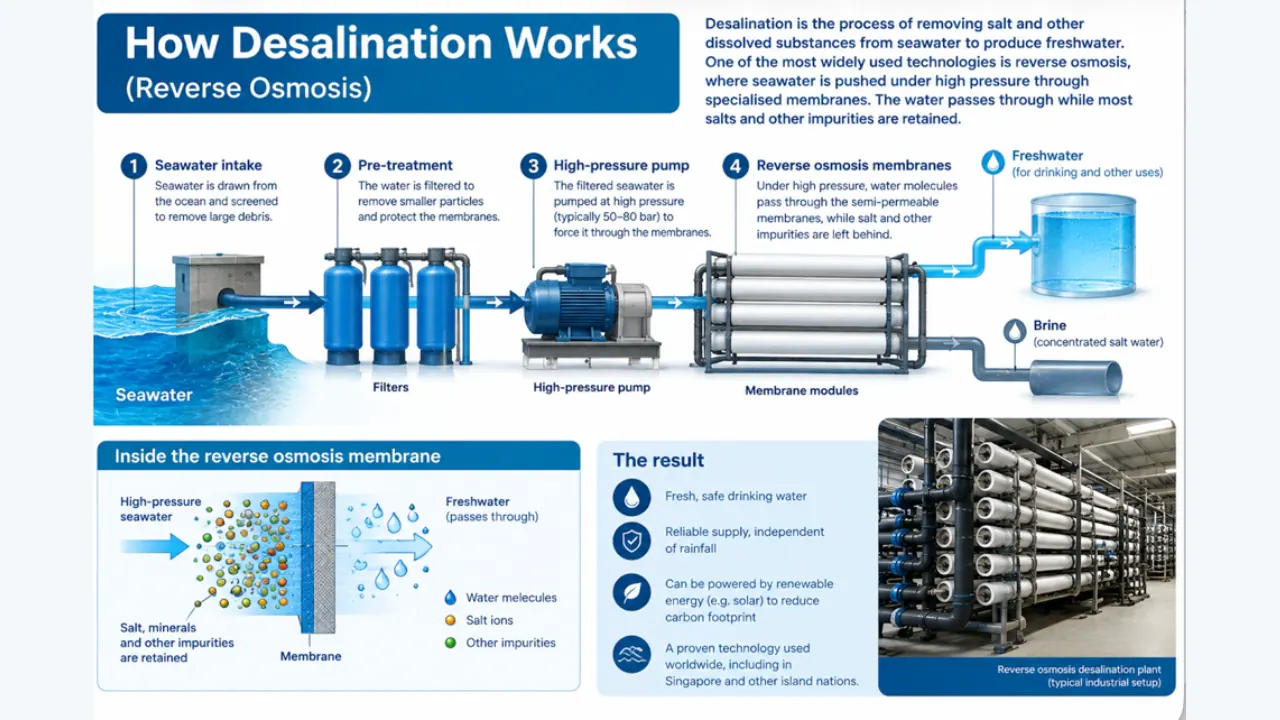
The government of Mauritius is exploring desalination as a potential solution to the country's water crisis. A proposed northern plant could produce between 10,000 and 50,000 cubic meters of drinking water per day, powered by solar energy. This move comes as the island nation faces an increasingly familiar problem: managing its water resources.
Desalination is not a new concept for Mauritius, and countries like Singapore have successfully incorporated it into their national water systems. The technology is proven, and its attraction lies in its ability to provide a source of water during prolonged dry periods, unaffected by seasonal rainfall.
However, Mauritius' water problem may not be a shortage, but rather a management issue. The country received approximately 3.402 billion cubic meters of rainfall in 2025, but this is unevenly distributed geographically and seasonally. Large quantities of water run off rapidly into rivers and ultimately the sea, highlighting the need for better storage capacity, groundwater recharge, and distribution infrastructure.
A significant issue lies underground, with the National Audit Office reporting that non-revenue water averaged around 60% nationally in 2024. Approximately 195 million cubic meters were classified as non-revenue water in 2024-25, largely due to ageing and defective pipelines. This creates a policy question: can desalination help address the issue, particularly in areas like the north where demand is increasing?
A northern desalination plant could provide an additional local source of potable water, with a capacity of 3.65 million cubic meters annually at 10,000 cubic meters per day, or 18.25 million cubic meters at 50,000 cubic meters per day. The proposed use of solar energy could improve the project's environmental profile, reducing dependence on fossil-fuel-generated electricity.
However, desalination is not without its challenges. The process requires substantial energy, and the discharge of brine into the sea can create local increases in salinity and affect marine ecosystems. Chemical residues associated with treatment processes also require proper management to avoid harming marine diversity and the tourism sector.
To be effective, any desalination plant in Mauritius must have a scientifically assessed seawater intake and brine-discharge system, continuous environmental monitoring, and clear safeguards for marine ecosystems. The example of Rodrigues, which has already used desalination, provides a useful lesson: desalination is infrastructure, not a magic solution, and it must be part of a broader national water strategy.
Key points
- Desalination can be part of the solution to Mauritius' water-security challenge, but it must be considered as one component of a broader national water strategy.
- The country needs to accelerate the replacement of ageing water pipes, improve rainfall capture and storage, and consider wastewater treatment and reuse.
- A scientifically assessed seawater intake and brine-discharge system is crucial to mitigate the environmental impact of desalination.