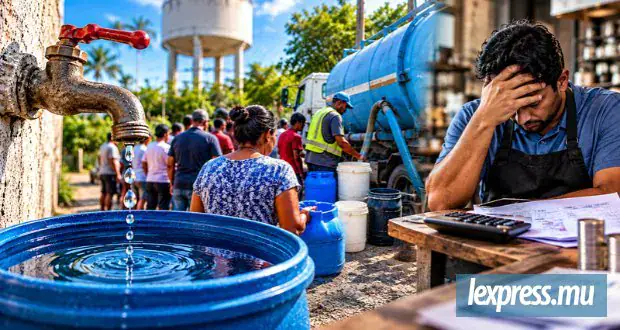
The Central Water Authority (CWA) in Mauritius is grappling with significant financial challenges, with six out of ten liters of water produced not generating any revenue. The authority's sales cover less than half of its expenses, while salaries absorb three-quarters of its revenue. The CWA's accounts have been flagged by auditors for two consecutive years. Despite this, water tariffs in Mauritius have remained unchanged since 2012.
According to Maurice Lam, a local expert, the problem of water in Mauritius is not just about rainfall, but also about the management of the network, maintenance of pipes, collection of bills, and financing of infrastructure. He advocates for a reform that combines rigorous management, investment, fair pricing, and transparency. Lam emphasizes that "expenditure is not performance." His views are supported by experts, including Prem Saddul, former director of the CWA, who argues that delaying tariff adjustments deprives the CWA of essential revenue for modernization.
Prem Saddul notes that the CWA can publish the volume of unbilled water every month, with figures ranging from 59% to 62%. He agrees that consumers should not be penalized for the CWA's inefficiencies in modernizing its treatment and distribution system. However, Saddul believes that consumers must pay for the services provided, citing the high daily water consumption per capita in Mauritius, which stands at 176 liters, compared to less than 145 liters in Europe and Singapore.
Dev Gujjalu, former chief engineer of the CWA and hydrology expert, also weighs in on the issue. He notes that the CWA's published reports on unaccounted-for water (UFW) stand at 60%, but this figure needs to be verified by ensuring the accuracy of production and consumer meters. Gujjalu highlights that water losses can be real or apparent, and that publishing figures on water losses requires a precise evaluation of these elements.
Gujjalu further emphasizes that future tariff adjustments should be based on the effective cost of water supply, accompanied by clear and enforceable performance obligations. However, he believes that this is an unrealistic expectation for Mauritius. The last tariff increase took into account a free monthly consumption of 6 cubic meters, but the water tariff in Mauritius remains too low, with a growing demand for improved services before any increase.
The CWA's financial struggles have significant implications for the country's water supply. With the current tariff structure, the authority is unable to finance improvements to its services. Experts argue that a balance between fair pricing and efficient management is necessary to address the challenges facing the CWA. The Mauritian government will need to consider these factors when making decisions about the country's water sector.
The water crisis in Mauritius highlights the need for a comprehensive approach to address the challenges facing the CWA. With the country's high water consumption and low tariffs, a reform of the water sector is long overdue. The government's decision on how to address these challenges will have a significant impact on the country's water supply and its economic development.
Key points
- The Central Water Authority in Mauritius faces significant financial challenges due to high water losses and low tariffs.
- Experts advocate for a reform that combines rigorous management, investment, fair pricing, and transparency to address the challenges facing the CWA.
- The Mauritian government's decision on how to address the water crisis will have a significant impact on the country's water supply and economic development.