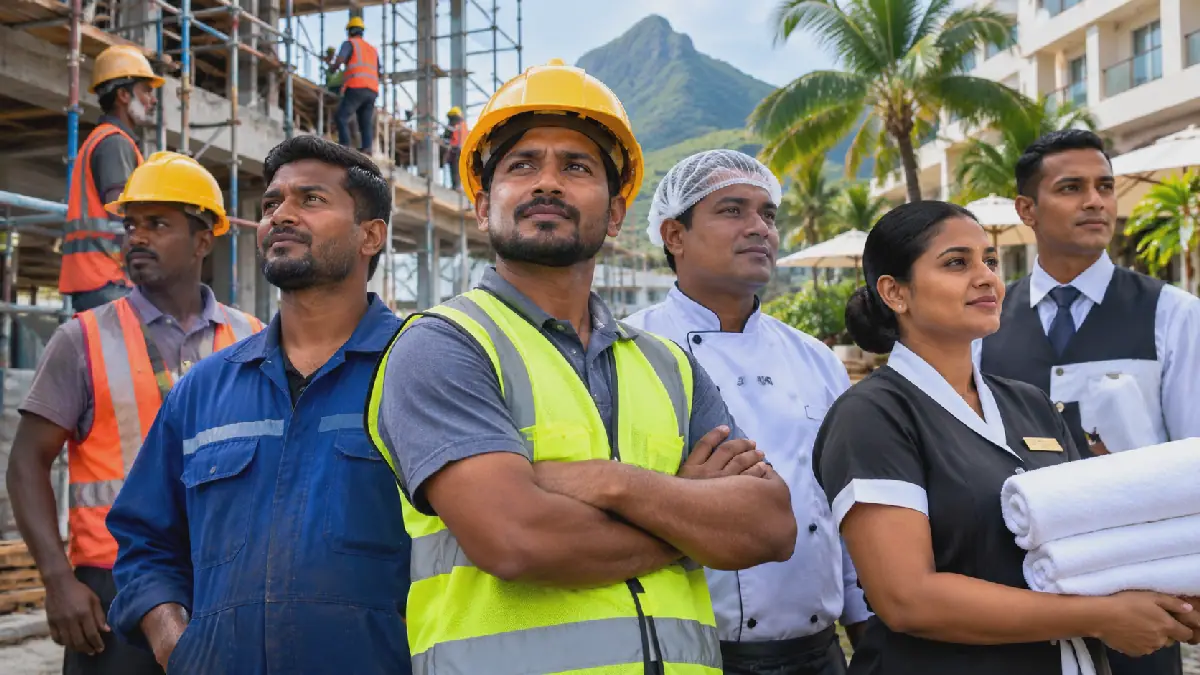
The government of Mauritius has initiated a study to assess the economic, social, and demographic impact of the growing number of foreign workers in the country. The Cabinet has authorized the Ministry of Labor and Industrial Relations to launch a consultation and recruitment process for a local team to conduct the study. The study aims to measure the contribution of foreign workers to growth and productivity, as well as identify the skills that Mauritius should develop locally.
Several sectors in Mauritius, including those facing labor shortages or specialized needs, rely on foreign workers. The study will differentiate between occupations with genuine shortages, jobs that can be filled through training, and activities where automation could reduce the need for workers. The terms of reference for the study include examining the contribution to growth, productivity, employment, demographic consequences, and social effects.
A key challenge for the study will be to avoid oversimplifying the issue of local versus foreign workers. The data collected will need to show which positions remain vacant, what salaries and conditions are offered, what qualifications are lacking, and how long it would take to train Mauritian workers. A sustainable policy also requires controlling living conditions, protecting against abuse, respecting contracts, and providing access to complaint mechanisms.
The study will need to clearly outline its methodology and sources to ensure its conclusions can be evaluated. The Ministry of Labor and Industrial Relations must select a consultant, followed by data collection, consultations, and the submission of a report. Although no timeline, budget, or detailed mandate has been published, the expected outcome is a public policy framework that balances labor immigration, local training, automation, and productivity.
The study's value will largely depend on the transparency of its data and the implementation of its recommendations into measurable decisions. The government aims to determine a sustainable level of foreign workers, not assume it. Several sectors, including healthcare and technology, have already expressed their reliance on foreign expertise to address skill gaps.
The Mauritian government has recognized the need for a comprehensive understanding of the impact of foreign workers on the country's economy and society. By conducting this study, the government hopes to develop a well-informed policy that addresses the needs of both local and foreign workers. The study's findings will likely have significant implications for Mauritius' labor market and economic development.
The study is expected to provide a nuanced understanding of the complex issues surrounding foreign workers in Mauritius. Its recommendations will be crucial in shaping the country's future labor policies and ensuring that the needs of both local and foreign workers are met. The government has not announced any conclusions on an ideal level of foreign workers, emphasizing the need for a thorough analysis.
Key points
- The study aims to measure the contribution of foreign workers to growth and productivity in Mauritius.
- The study will examine the impact of foreign workers on demographics and social effects in Mauritius.
- The study's outcome will inform a public policy framework balancing labor immigration, local training, automation, and productivity.