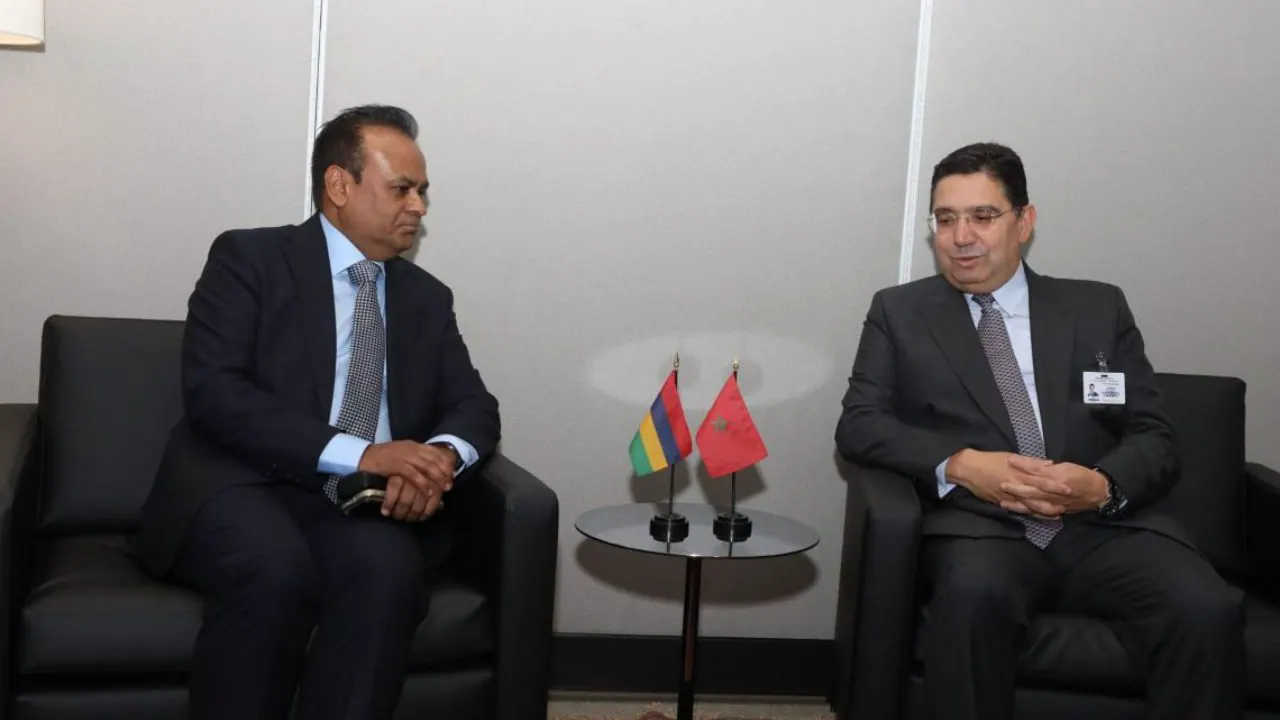
The government of Mauritius has reaffirmed its support for the Moroccan autonomy plan for Western Sahara, marking a significant shift in its diplomatic stance on the decades-long conflict. According to Foreign Minister Dhananjay Ramful, Mauritius now views autonomy under Moroccan sovereignty as the most credible solution to the dispute. This position was announced after a meeting with Moroccan Foreign Minister Nasser Bourita on the sidelines of the 81st session of the United Nations General Assembly in New York.
This development confirms a change in Mauritius' diplomatic approach, which was initially signaled by the Council of Ministers in May 2026. The Council had announced that Mauritius would adapt its position on Western Sahara in accordance with UN Security Council Resolution 2797. The resolution, adopted on October 31, 2025, emphasizes the Moroccan autonomy plan as a basis for negotiations while reaffirming the goal of a solution that ensures the self-determination of the people of Western Sahara.
The UN Security Council Resolution 2797 marks a significant evolution in the handling of the Western Sahara dossier. The resolution, adopted with 11 votes in favor, no votes against, and three abstentions, extends the mandate of the UN Mission for the Referendum in Western Sahara (MINURSO) until October 31, 2026. The resolution supports negotiations based on the Moroccan autonomy plan and considers that "a genuine autonomy could represent one of the most viable solutions."
The Western Sahara conflict remains one of the main unresolved decolonization issues in Africa. The territory, a former Spanish colony, has been on the UN list of non-self-governing territories since 1963. After Spain's withdrawal in 1976, the conflict pitted Morocco against the Polisario Front, which claims independence for the territory. Morocco controls most of Western Sahara and considers it an integral part of the kingdom, while the Polisario Front advocates for an independent Sahrawi state.
The Moroccan autonomy plan, presented in 2007, has become a central element of Rabat's diplomatic strategy. The plan proposes autonomy for Western Sahara within the framework of Moroccan sovereignty. While Resolution 2797 does not imply recognition of Moroccan sovereignty over Western Sahara, it places the autonomy plan at the center of negotiations under UN auspices. The resolution continues to call for a definitive and mutually acceptable political solution that ensures the self-determination of the people of Western Sahara.
Mauritius' new position is significant given its diplomatic history on the issue. Mauritius had recognized the Sahrawi Arab Democratic Republic (SADR) in July 1982 but withdrew this recognition in January 2014. The government's current stance marks a new stage, as Mauritius now explicitly supports the Moroccan autonomy plan. This development brings Mauritius closer to Morocco on a dossier considered a priority by Rabat, particularly in a sensitive African context.
The shift in Mauritius' position may have implications for the African and international diplomatic landscape on Western Sahara. The SADR remains a member of the African Union, as does Morocco, which rejoined the continental organization in 2017. African states remain divided on the issue, with some supporting the Moroccan autonomy plan and others emphasizing the right to self-determination for the Sahrawi people.
Key points
- Mauritius now considers autonomy under Moroccan sovereignty as the most credible solution to the Western Sahara conflict.
- The UN Security Council Resolution 2797 supports negotiations based on the Moroccan autonomy plan.
- Mauritius' new position brings it closer to Morocco on the Western Sahara issue.