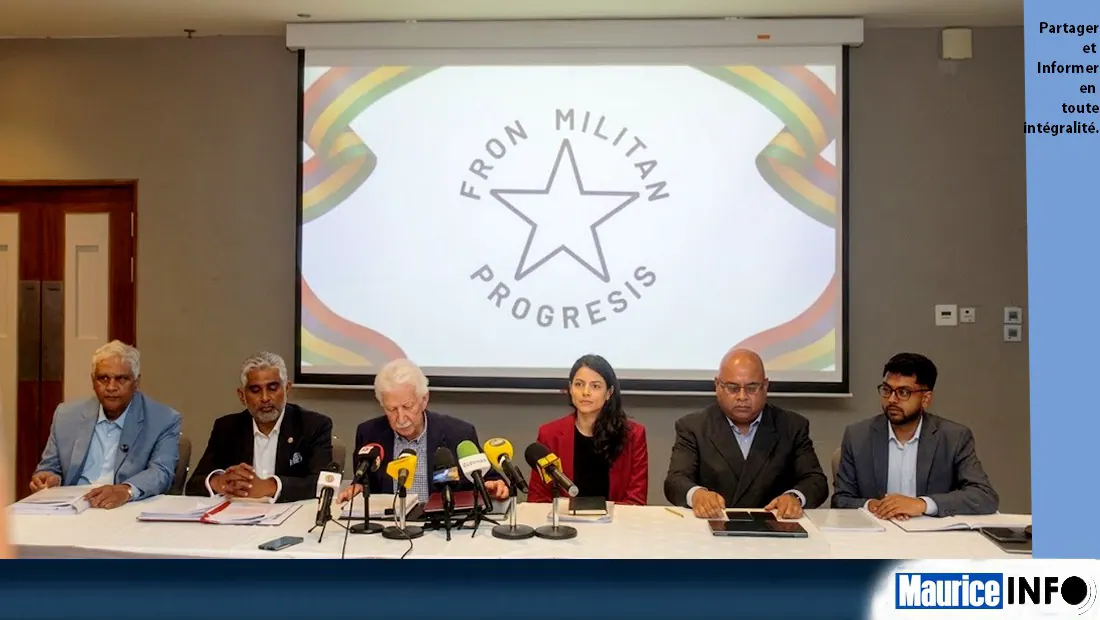
The Front Militant Progressiste (FMP), a Mauritian opposition party, held a press conference on September 19, 2026, at the Hennessy Park Hotel to express its strong opposition to the government's proposed National Crime Agency (NCA) bill. Party leaders, including Paul Bérenger, Chetan Baboolall, Joanna Bérenger, and members of the legal profession, criticized the bill as a flawed imitation of outdated British models.
According to Paul Bérenger, the NCA bill is an "absurdity" that could undermine the authority of the Commissioner of Police (CP), a position guaranteed by the Constitution. He noted that in the UK, the NCA was established in 2013 and is now being reorganized to be part of a centralized National Police Service. In contrast, the Mauritian bill proposes creating an entity that could override the CP's authority, which Bérenger sees as a significant degradation of democratic institutions.
Chetan Baboolall focused on Clause 53 of the bill, which relates to control and surveillance operations. He warned that the bill would allow investigative officers to intercept communications and collect private data without judicial oversight or prior authorization from a judge. The FMP argues that this would establish a disproportionate surveillance regime that directly threatens citizens' privacy and bypasses existing constitutional guarantees.
The FMP's legal team, including Rama Valayden and Neelkanth Dulloo, denounced the appointment process for the Director General, citing concerns over the concentration of power in the Prime Minister's hands. The bill proposes that the Prime Minister have absolute power to appoint an interim director without a strict mandate limit, who would then automatically become the first Director General for a four-year term, renewable once.
The FMP also criticized the composition of the Independent Advisory Panel, which would be responsible for future nominations. The panel would consist of three foreign nationals, which Bérenger argued was an affront to local expertise and ignored the country's sovereignty. The party asserts that several clauses of the NCA bill undermine the principle of separation of powers and judicial independence.
The FMP demanded the immediate withdrawal of the bill and threatened to challenge its constitutionality in the Supreme Court and, if necessary, before the Privy Council. Paul Bérenger announced a series of public forums across the island to raise awareness about the democratic implications of the bill, which will be debated in the National Assembly when it reconvenes on October 20, 2026.
The opposition party's concerns about the bill's impact on democratic institutions and citizen privacy are set to spark a significant debate in the coming weeks. The FMP's efforts to raise awareness and challenge the bill's constitutionality will likely be closely watched by the Mauritian public and international observers.
Key points
- The FMP opposes the National Crime Agency bill, citing concerns over its impact on democratic institutions and citizen privacy.
- The bill proposes creating an entity that could override the authority of the Commissioner of Police, a position guaranteed by the Constitution.
- The FMP demands the immediate withdrawal of the bill and threatens to challenge its constitutionality in the Supreme Court and, if necessary, before the Privy Council.