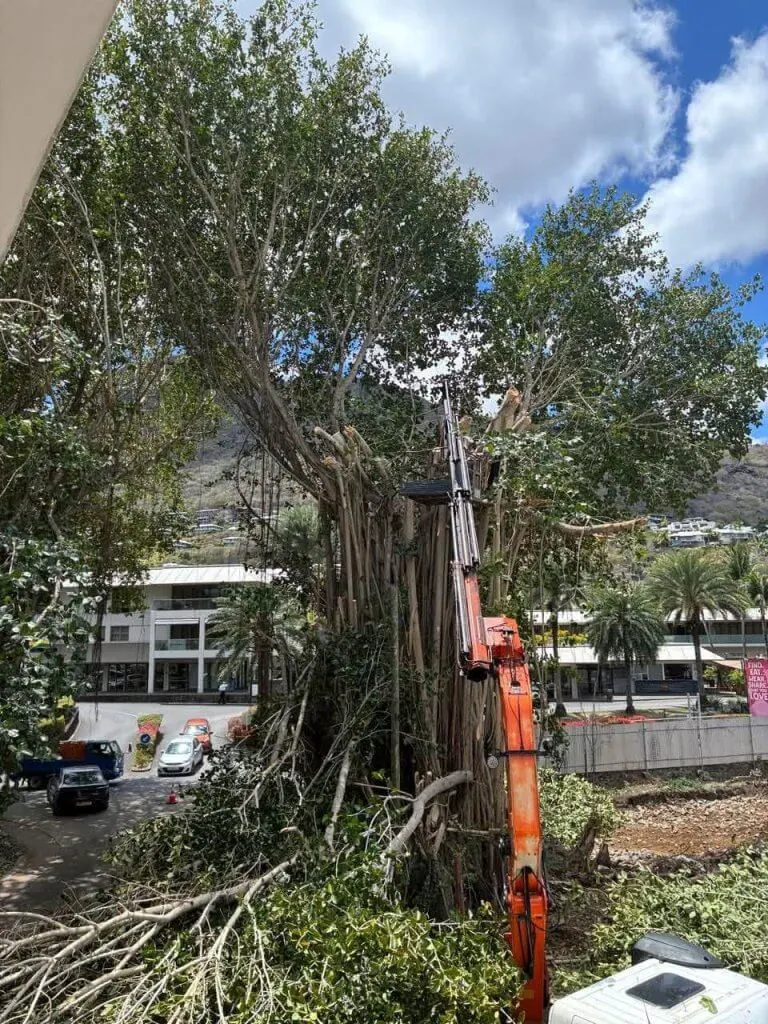
A historic banyan tree, estimated to be 80-100 years old, was recently felled in Mauritius, leaving many in the community devastated. The tree, located in Rivière Noire, was not just any ordinary tree but a vital part of the island's ecosystem and cultural heritage. It provided shade, sheltered birds and bats, and played a crucial role in maintaining the soil quality. The tree's removal has raised concerns about the government's priorities and its commitment to preserving the island's natural beauty.
The author of the article, Doris Félix, expressed her outrage and sadness over the tree's demise, likening it to the execution of an elderly person. She emphasized that the tree was not just a plant but a living being with a family of organisms living in and around it. Félix highlighted the importance of trees in regulating the climate, producing oxygen, and supporting biodiversity. She also pointed out that the tree's removal was a loss for the community, as it had been a popular spot for children to play.
The article highlights the significance of trees in mitigating the effects of climate change. According to scientific research, a single tree can transpire hundreds of liters of water per day, contributing to the formation of clouds and precipitation. Trees also act as natural air conditioners, reducing the temperature in urban areas by 2-8 degrees Celsius. The removal of the banyan tree has raised concerns about the government's approach to development and its impact on the environment.
The concept of the "Wood Wide Web" is also discussed in the article, which refers to the network of fungi that connect trees and allow them to communicate and share resources. Research has shown that trees are interconnected and can warn each other of potential dangers. The author argues that the removal of the banyan tree was not just a loss for the community but also had a ripple effect on the entire ecosystem.
In contrast to Mauritius, other countries have adopted more sustainable approaches to development. In Japan, for example, ancient trees are not cut down but rather relocated using a technique called Nemawashi. This approach involves carefully preparing the tree's roots and relocating it to a new site, ensuring minimal disruption to the ecosystem. The author argues that Mauritius can learn from this approach and adopt more sustainable practices.
The article also highlights the alarming rate of deforestation in Mauritius. Over 10,500 hectares of agricultural land have been covered in concrete, leading to soil erosion and water scarcity. The removal of trees has also had a devastating impact on the island's biodiversity and aesthetic appeal. The author argues that it is essential to protect the remaining trees and prevent further deforestation.
The author concludes by calling for greater protection and conservation of Mauritius' trees. She proposes that the government establish a registry of ancient trees and introduce stricter regulations to prevent their removal. The author also suggests that the government adopt a more sustainable approach to development, one that balances economic growth with environmental protection.
Key points
- The removal of the ancient banyan tree in Mauritius has sparked outrage and raised concerns about the government's commitment to environmental conservation.
- Trees play a crucial role in mitigating the effects of climate change, and their removal can have a devastating impact on the ecosystem.
- Mauritius can learn from other countries' sustainable approaches to development, such as Japan's Nemawashi technique, to protect its natural heritage.