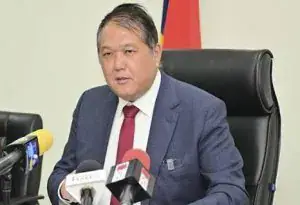
Michaël Sik Yuen, the Minister of Commerce in Mauritius, has refused to disclose the second contract between the State Trading Corporation (STC) and Sahara Energy Resource Ltd, citing the company's disagreement with the disclosure. This decision has raised concerns about transparency in the country's energy sector. Sik Yuen had previously accepted a similar request to disclose the previous contract with Sahara Energy on April 14, 2026.
The controversy began when Joe Lesjongard, a member of parliament, asked Sik Yuen to provide details of the new contract, including the offers received, the negotiated premiums, and a copy of the agreement. The STC had awarded a contract to Sahara Energy in December 2024, following a series of urgent procurement procedures. The company was awarded a contract for the supply of heavy fuel oil for the period from April 1, 2025, to March 31, 2026.
The initial contract with Sahara Energy was signed on March 19, 2025, and provided for premiums of $70.81 per tonne for HSFO 180 CST Catalytic Cracked, $78.04 for HSFO 180 CST Straight-Run, and $68.74 for HSFO 380 CST Straight-Run. However, the details of the new contract, including the premiums and prices, have not been disclosed. The lack of transparency has raised concerns about the cost of the fuel and its impact on the country's electricity tariffs.
The STC had launched a new tender for the supply of heavy fuel oil for 2026-2027, but the process was marred by controversy. Two of the lowest bidders were disqualified after a due diligence exercise, and the tender was subsequently cancelled. A second tender was launched on March 9, 2026, with a submission deadline of just 48 hours. Sahara Energy was again awarded the contract, but the details of the agreement have not been disclosed.
The opposition has questioned the government's decision to award the contract to Sahara Energy without disclosing the details. They have also expressed concerns about the impact of the high premiums on the country's electricity tariffs. The Central Electricity Board (CEB), the main recipient of the heavy fuel oil, has faced criticism for the 15% increase in electricity tariffs.
The government has argued that the contract contains sensitive information and that the disclosure would not be in the public interest. However, the opposition has argued that the public has a right to know the details of the contract, given the significant impact on the country's energy sector and electricity tariffs.
The controversy has raised questions about the transparency and accountability of the government's procurement processes. The country's energy sector is a strategic sector that requires transparency and accountability. The government must balance the need for transparency with the need to protect sensitive information.
Key points
- The Minister of Commerce in Mauritius, Michaël Sik Yuen, has refused to disclose the second contract with Sahara Energy, citing the company's disagreement.
- The contract details, including premiums and prices, have not been disclosed, raising concerns about the cost of fuel and its impact on electricity tariffs.
- The opposition has questioned the government's decision to award the contract to Sahara Energy without disclosing the details, citing concerns about transparency and accountability.