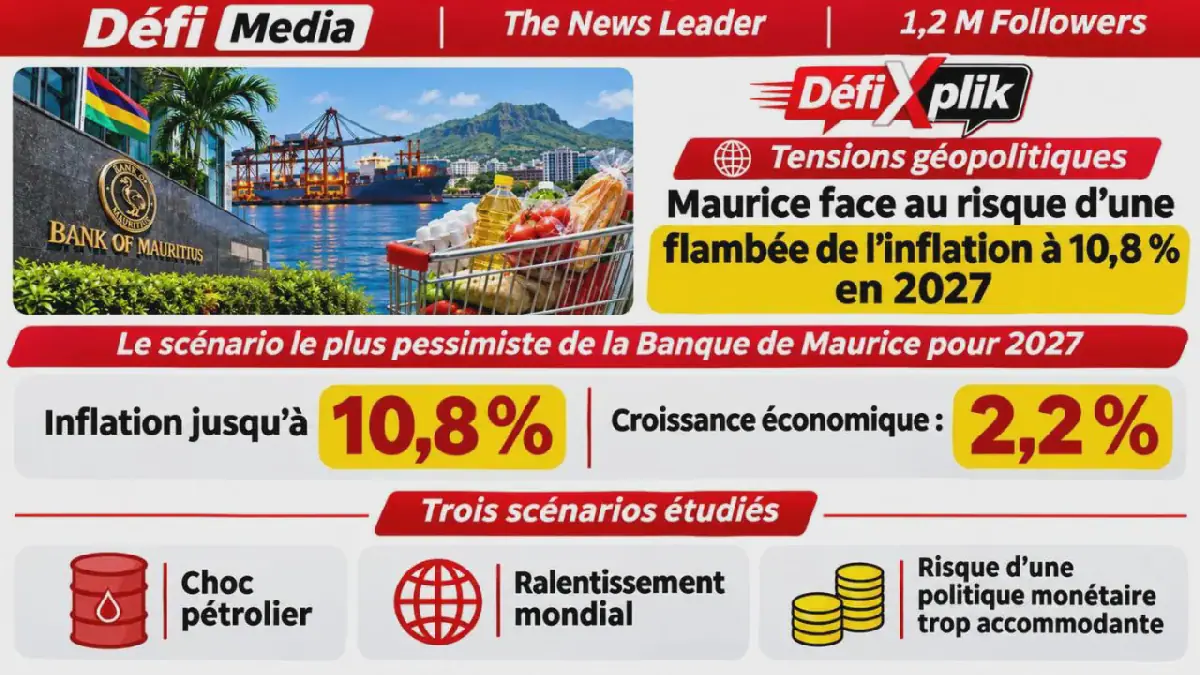
The Bank of Mauritius has outlined several scenarios for 2027 in its latest Monetary Policy Report, highlighting the risks of higher inflation and slower growth. The report notes that Mauritius is vulnerable to international tensions due to its reliance on imports for a significant portion of its consumption. As a result, increases in oil prices or maritime transportation costs can quickly impact fuel, electricity, and food product prices, affecting businesses and households alike.
The Bank of Mauritius presents three possible scenarios for 2027. The first scenario, a return to normal, assumes that tensions will ease in the first half of 2027, leading to 3.2% growth and 5.5% inflation. The second scenario, prolonged tensions, foresees continued disruptions until the second half of 2027, resulting in 8.8% inflation and 2.5% growth. The third and most severe scenario, an escalation, anticipates significant disruptions to energy supplies and maritime trade, potentially driving oil prices to $150 per barrel in the first quarter, with inflation reaching 10.8% and growth slowing to 2.2%.
A delayed monetary policy response also poses a risk, as inflationary pressures could worsen if the Bank of Mauritius fails to raise interest rates promptly. In this scenario, the policy rate would remain unchanged in November 2026 and throughout 2027, leading to decreased real interest rates and a more accommodative monetary policy. Initially, growth would be supported at 3.6%, but inflation would reach 9.8% in 2027 and 10.6% in 2028, with growth subsequently declining to 1.8% in 2028.
The consequences of higher inflation for households in Mauritius would be significant, as a 10.8% inflation rate does not mean that all prices will increase by the same proportion. However, essential expenses such as food, transportation, and electricity could have a more substantial impact on family budgets. Businesses and the tourism sector may also be affected by the global economic slowdown.
To navigate these challenges, several key indicators need to be monitored, including the evolution of conflicts in the Middle East, oil prices, food prices, maritime transportation costs, and the decisions of the Bank of Mauritius. The primary challenge is to contain price increases without further slowing economic growth.
The Bank of Mauritius's scenarios highlight the complexities of managing inflation and growth in a volatile global environment. The country's vulnerability to international shocks underscores the importance of prudent monetary policy and careful monitoring of economic developments.
As 2027 approaches, stakeholders in Mauritius will be closely watching the Bank of Mauritius's actions and the trajectory of global events to understand the potential impact on the country's economy and the cost of living for its citizens.
Key points
- Mauritius may experience higher inflation in 2027 due to geopolitical tensions and potential delayed monetary policy response.