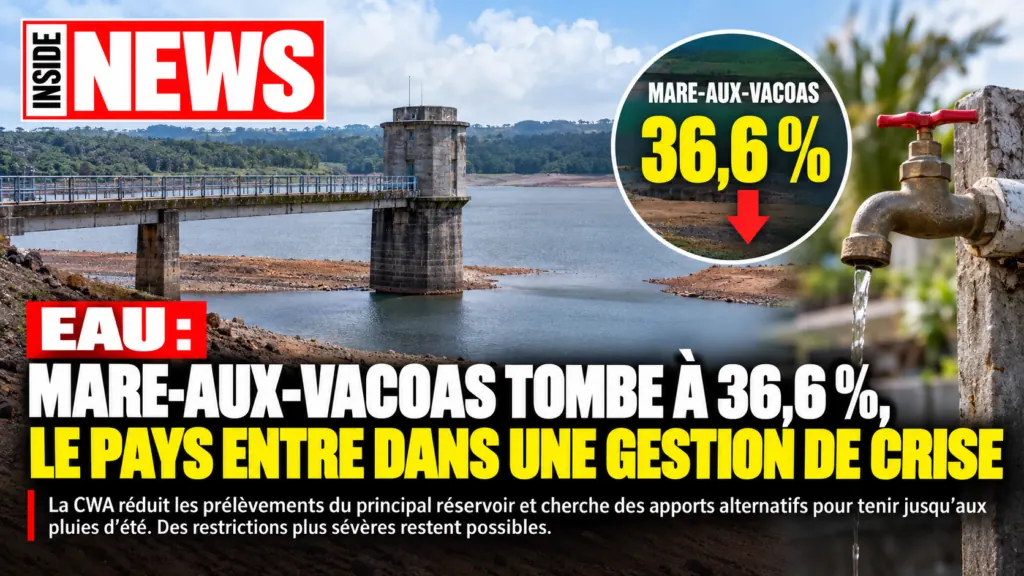
The Central Water Authority (CWA) of Mauritius has begun reducing water extraction from the Mare-aux-Vacoas reservoir, the country's primary water source, as it struggles to maintain supply amid dwindling water levels. On October 2, the reservoir was reported to be at 36.6% capacity. In response, the CWA is exploring alternative sources, including Mare-Longue, Pétrin, Rivière-Papayes, and certain boreholes, to sustain water distribution until the summer rains.
The Mauritian government has activated a crisis committee, led by the Minister of Energy and Public Services, to address the urgent need for water conservation. This committee aims to assess the situation and implement immediate measures to mitigate the effects of low water levels and forecasted dry weather. The activation of the crisis committee signals a critical phase in managing the country's water reserves.
The reduction in water levels at Mare-aux-Vacoas has already impacted operations, with a 36% decrease in water supply to the La Marie treatment plant. To manage this shortfall, the CWA is not only reducing withdrawals from Mare-aux-Vacoas but also mobilizing water from other sources and utilizing private tanker trucks as part of its emergency response strategy.
According to Shiam Thannoo, Director General of the CWA, Mare-aux-Vacoas currently supplies approximately 75,000 cubic meters of water per day to served regions, down from a normal 110,000 cubic meters. The immediate goal is to preserve water reserves until early December. The situation may necessitate further restrictions if water levels continue to decline.
The water crisis in Mauritius is not solely attributed to consumer behavior but also to systemic issues such as water losses in the network, storage capacity constraints, and dependence on a few large reservoirs. The crisis committee is expected to monitor and publicly report on various indicators, including reservoir levels, production and distribution volumes, and regions affected.
In an effort to support households, the government advises reducing non-essential water use and checking distribution schedules. Additionally, the Water Tank and Domestic Water Pump Grant Scheme offers assistance to households, providing, under certain conditions, a water tank, pump, and accessories valued at Rs 15,000 to help manage water needs.
Looking ahead, the situation remains critical, with the potential for more severe restrictions if current trends persist. The effectiveness of the crisis management measures and the responsiveness of the population will be crucial in navigating this challenging period. The government's proactive steps, including the establishment of a crisis committee and public awareness campaigns, aim to mitigate the impact of the water shortage.
Key points
- The Mare-aux-Vacoas reservoir, a key water source in Mauritius, has dropped to 36.6% capacity as of October 2.
- The Mauritian government has activated a crisis committee to address the water shortage and implement conservation measures.
- The country is exploring alternative water sources and implementing restrictions to manage the water supply until the summer rains.