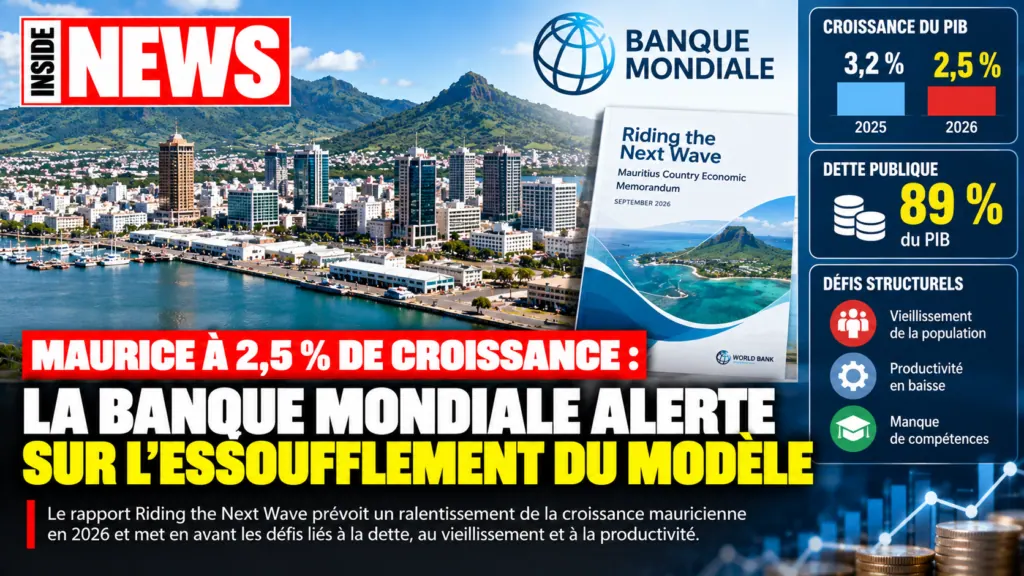
The World Bank has released a report, Riding the Next Wave, which projects Mauritius' economic growth to slow down to 2.5% in 2026, down from 3.2% in 2025. This forecast was made public on September 30. The report also highlights that the country's public debt stands at around 89% of its GDP. However, it is essential to consider the various definitions of debt, including gross debt, central government debt, and public sector debt, which may not cover the same scope.
The slowdown in economic growth raises concerns about the government's ability to finance infrastructure, public services, social assistance, and investments. The World Bank identifies several structural constraints that may impact Mauritius' economic growth. The aging population is putting pressure on public spending and the labor market. Additionally, productivity challenges are limiting the economy's ability to create more value. The lack of suitable skills is also making it difficult to recruit in sectors with higher growth.
A sustained slowdown in economic growth would have significant implications for businesses and employees. Companies would face increased pressure on costs, investment, and employment. Workers would be concerned about wage growth and the creation of better-paying jobs. Despite these challenges, Mauritius has several promising sectors, including financial services, tourism, technology, the blue economy, and knowledge-based industries, which can still support growth.
However, the development of these sectors will depend on the quality of skills, private investment, and the government's ability to maintain sustainable public finances. The World Bank's report emphasizes the need for Mauritius to address these structural challenges to sustain economic growth. The government's budget will be closely monitored, with a focus on actual growth and debt trajectory.
The report highlights the importance of investing in education and training to address the skills gap. This would enable Mauritius to develop a more competitive workforce and attract higher-value investments. Furthermore, the government must prioritize fiscal sustainability to maintain investor confidence and ensure that public finances are managed effectively.
Mauritius has a history of strong economic growth, but the current challenges require a more nuanced approach. The government must balance the need to invest in infrastructure and public services with the imperative of maintaining fiscal sustainability. The World Bank's report provides a timely warning, and the government must take heed to ensure that Mauritius' economic growth remains resilient.
In conclusion, Mauritius faces significant challenges in sustaining economic growth, including a slowdown in growth to 2.5% in 2026, high public debt, and structural constraints such as an aging population and productivity challenges. The government must prioritize investing in education and training, fiscal sustainability, and private sector development to ensure that Mauritius' economy remains competitive and resilient.
Key points
- Mauritius' economic growth is projected to slow down to 2.5% in 2026, citing debt, aging population, and productivity challenges.
- The World Bank warns of the need for Mauritius to address structural challenges, including investing in education and training, to sustain economic growth.
- The government's budget will be closely monitored, with a focus on actual growth and debt trajectory.