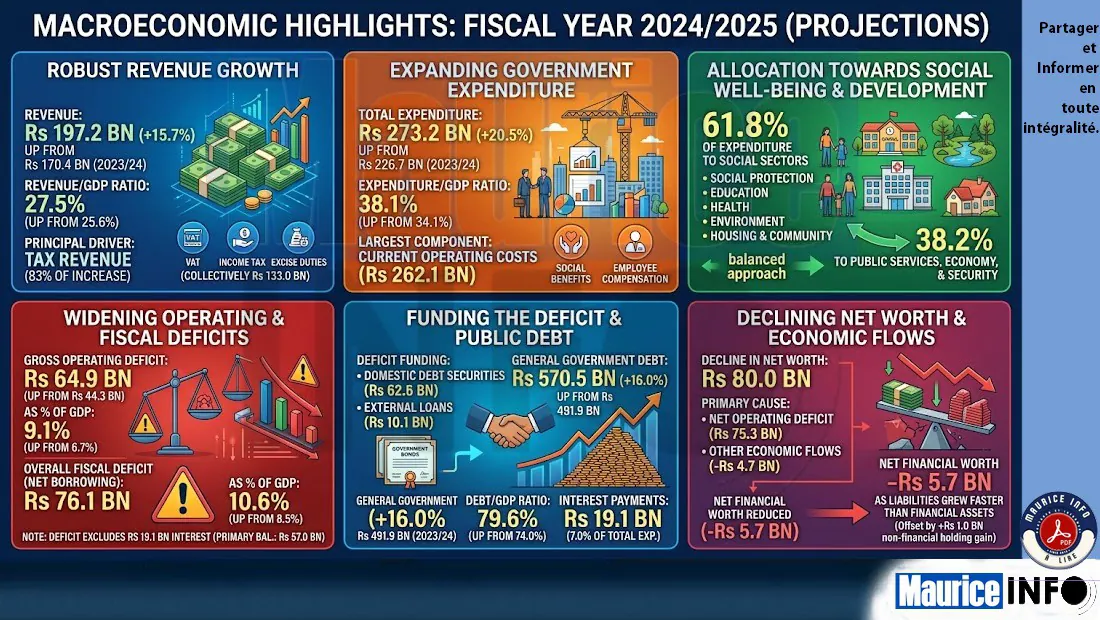
The consolidated general government of Mauritius recorded a significant 15.7% growth in revenue, reaching around Rs 197.2 billion in the fiscal year 2024/2025, up from Rs 170.4 billion in the previous year. This performance led to a higher revenue-to-GDP ratio, rising from 25.6% to 27.5%. Tax revenue was the primary driver of this expansion, contributing nearly 83.0% of the overall increase in revenue.
Within the tax revenue category, Value-Added Tax (VAT), taxes on income and profits, and excise duties remained the primary streams, collectively contributing a substantial Rs 133.0 billion to government receipts. This demonstrates strong tax buoyancy, with total tax receipts increasing at nearly twice the rate of nominal GDP growth. The government's revenue growth was a notable achievement, reflecting a robust economic performance.
However, expenditure reached Rs 273.2 billion in 2024/2025, representing an increase of 20.5% from Rs 226.7 billion in the fiscal year 2023/2024. Current operating costs constituted the largest share of spending at Rs 262.1 billion, led primarily by outlays for social benefits and employee compensation. The consumption of fixed capital accounted for Rs 10.3 billion, contributing to a higher expenditure-to-GDP ratio of 38.1%.
Despite high recurrent spending, the government continued to invest in vital physical and non-produced assets, albeit at a slower pace. Gross investment in non-financial assets declined slightly from Rs 11.9 billion in 2023/2024 to Rs 11.1 billion in 2024/2025. Nevertheless, net acquisition of these assets remained positive at approximately Rs 0.8 billion in 2024/2025, indicating a continued expansion of the government’s stock of non-financial assets.
The government prioritized its allocation strategy by directing 61.8% of total expenditure towards social development and public well-being, specifically social protection, education, health, environmental protection, housing, and community amenities. Concurrently, 38.2% was allocated to general public services, economic affairs, and security, maintaining a balanced approach that supports both social welfare and economic resilience.
Although revenue growth remained robust in 2024/2025, it was outpaced by a sharper rise in current expenses, resulting in a gross operating balance deficit of Rs 64.9 billion, compared to a deficit of Rs 44.3 billion in 2023/2024. The overall fiscal balance, captured by net lending/net borrowing, recorded a deficit of Rs 76.1 billion in 2024/2025, with interest costs accounting for one-quarter (25.1%) of this overall gap.
The government maintained a net deficit during the year under review, requiring additional financing to bridge the gap between total revenue and total expenditure. The debt stock grew by 16.0%, expanding from Rs 491.9 billion at the end of 2023/2024 to Rs 570.5 billion at the end of 2024/2025, with the debt-to-GDP ratio climbing from 74.0% to 79.6%. The net worth of the consolidated general government declined by Rs 80.0 billion in 2024/2025, primarily driven by a substantial net operating deficit of Rs 75.3 billion.
Key points
- Revenue grew by 15.7% to reach around Rs 197.2 billion in 2024/2025.
- Expenditure reached Rs 273.2 billion in 2024/2025, representing an increase of 20.5% from the previous fiscal year.
- The debt stock grew by 16.0%, expanding from Rs 491.9 billion to Rs 570.5 billion at the end of 2024/2025.