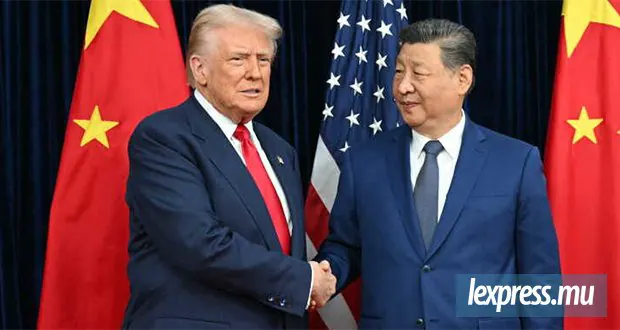
The recent meeting between US President Donald Trump and Chinese President Xi Jinping in Washington has significant implications for global trade and diplomacy. The two leaders agreed to extend a commercial truce and reduce tariffs on $30 billion worth of goods. China also committed to purchasing US coal, and both countries will establish new communication channels, particularly on artificial intelligence. This development has far-reaching consequences for countries like Mauritius, which must navigate the complexities of US-China relations.
The Trump-Xi summit primarily showcased a stalemate in US-China relations, with both sides exercising restraint in their rivalry. However, the underlying tensions remain, particularly in the areas of technology and trade. China continues to protect its rare earth minerals, while the US maintains strict controls on advanced semiconductors. Taiwan, a critical issue in US-China relations, was not a focal point of the summit but remains a point of contention.
The intersection of technology and diplomacy is becoming increasingly important in global politics. The US and China are vying for dominance in areas like artificial intelligence, 5G networks, and data security. For countries like Mauritius, this shift presents both opportunities and challenges. As the global economy becomes more interconnected, Mauritius must carefully consider its relationships with major powers and ensure that its economic and strategic interests are protected.
China's Ambassador to Mauritius, Huang Shifang, recently published an article highlighting Beijing's vision for its global role. China aims to promote development, openness, responsibility, and partnerships, while showcasing its advancements in high-tech industries, digitalization, and renewable energy. Huang also emphasized the growth of Mauritian exports to China, underscoring the importance of bilateral trade relations.
As Mauritius navigates its relationships with the US and China, the country must prioritize its sovereignty and economic interests. With the 55th anniversary of Mauritian-Chinese diplomatic relations approaching, Huang reaffirmed China's support for Mauritius's stance on the Chagos Islands. Mauritius must balance its ties with both the US and China, avoiding alignment with either side while fostering partnerships that promote economic growth and strategic cooperation.
The lessons of history can provide valuable insights for Mauritius as it navigates the complexities of global politics. The ancient Silk Road, which connected Asia to Europe, demonstrates the power of trade and diplomacy in fostering cooperation between nations. As the global economy evolves, Mauritius can draw on this experience to promote its interests and avoid becoming entangled in the rivalries of major powers.
As global powers continue to erect barriers and engage in rivalries, small states like Mauritius face significant challenges. The country's position as a bridge between different regions and cultures can be an asset, but it must also be prepared to adapt to changing circumstances. By diversifying its partnerships and prioritizing its economic and strategic interests, Mauritius can ensure its continued growth and stability in a rapidly shifting global landscape.
Key points
- Mauritius must navigate complex US-China relations while prioritizing its sovereignty and economic interests.
- The shift in global politics towards technology and trade presents both opportunities and challenges for Mauritius.
- Historical lessons, such as those from the Silk Road, can provide valuable insights for Mauritius as it navigates the complexities of global politics.