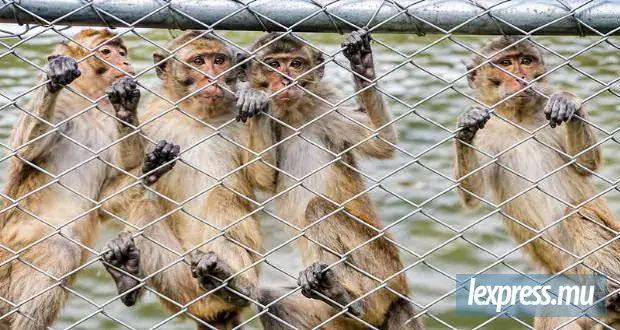
A recent report by Animal Alliance of Canada, PETA, and Abolición Vivisección has revealed that Mauritius is a key supplier of wild monkeys to Canada. The report, titled "Endangered and unprotected: How Canada became a hub in the global long-tailed macaque trade," found that 1,857 macaques declared to be captured in the wild in Mauritius were imported to Canada between 2021 and 2024. This accounts for nearly all of the wild-caught macaques imported to Canada during this period.
The report highlights concerns about the welfare of these animals during transportation. According to inspection reports from the US Department of Agriculture, monkeys are transported in small wooden crates, often stacked on top of each other, and may go without water for extended periods. In one instance, 616 macaques from Mauritius were found to have gone without water for 18-24 hours during a flight. Canadian regulations permit up to 36 hours of transport without food or water for these animals.
The macaque trade has significant financial implications, with each monkey selling for between $15,000 and $20,000 in Canada. The report's authors argue that exporting wild animals to laboratories contradicts the spirit of the Convention on International Trade in Endangered Species of Wild Fauna and Flora (CITES). The long-tailed macaque is classified as endangered by the International Union for Conservation of Nature.
The report has sparked calls for greater transparency and regulation in the primate trade. The association Monkey Massacre in Mauritius is demanding that authorities investigate the matter and ensure that exporters comply with regulations. They want to know how exported monkeys are tracked and what permits are required for their trade.
Canada's importation of primates is largely driven by demand from laboratories. The country imported 1,885 primates declared to be wild between 2021 and 2024, with 1,857 of them being long-tailed macaques from Mauritius. The remaining 28 primates came from Cambodia.
The transportation of monkeys from Mauritius to Canada involves complex logistics. Flights typically depart from Mauritius' Sir Seewoosagur Ramgoolam International Airport, make a stop in Poland, and then continue to the United States before finally arriving in Montreal.
The issue raises questions about Mauritius' role as a supplier of wild animals and its responsibilities under CITES. Authorities in Mauritius are being urged to take a closer look at the primate trade and ensure that exporters are complying with regulations.
Key points
- 1,857 wild macaques from Mauritius were imported to Canada between 2021 and 2024.
- The long-tailed macaque is classified as endangered by the International Union for Conservation of Nature.
- The report has sparked calls for greater transparency and regulation in the primate trade.