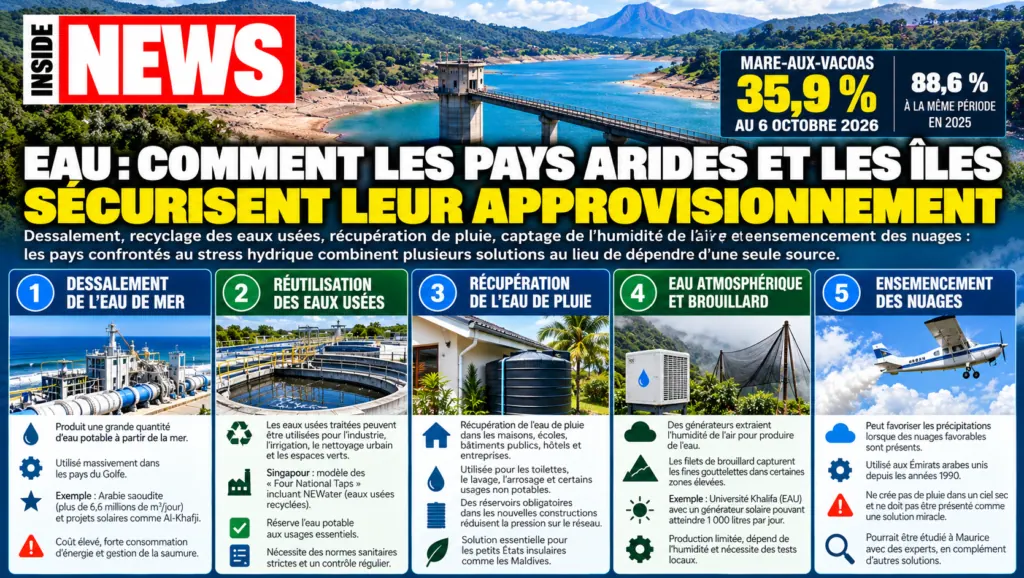
As Mauritius faces its current water crisis, the question arises of how countries with limited rainfall and natural water resources manage to secure their water supply. The answer lies in diversifying their sources, rather than relying on a single one. Advanced countries have developed systems that combine rainwater harvesting, groundwater, desalination, wastewater reuse, and efficient distribution networks. This multi-faceted approach enables them to mitigate the effects of water scarcity.
In the Middle East, desalination has become a strategic infrastructure. Saudi Arabia, for instance, relies heavily on the Saline Water Conversion Corporation (SWCC), which produces over 6.6 million cubic meters of desalinated water per day. The desalinated water is then transported to cities through extensive pipeline networks, reservoirs, and pumping stations. Additionally, Saudi Arabia is investing in renewable energy-powered desalination units, such as the Al-Khafji project, one of the world's largest solar-powered desalination projects.
Desalination, however, comes with a high cost, requiring significant amounts of electricity, specialized facilities, and careful management of the brine discharged back into the sea. For Mauritius, desalination could be a viable solution in certain coastal areas, such as for hotels, industries, or as a strategic reserve. Nevertheless, it would not replace the island's existing reservoirs and natural water sources. Other countries have also adopted innovative approaches to address their water needs.
Singapore is often cited as a exemplary case, having developed the "Four National Taps" – four complementary sources of water. These include locally captured water, imported water, recycled water (NEWater), and desalinated water. NEWater is produced from treated wastewater through a multi-step process, including microfiltration, reverse osmosis, and ultraviolet disinfection. The recycled water is primarily used by industries and certain facilities, with some being reintroduced into reservoirs for further treatment and distribution.
The concept of reusing treated wastewater is crucial for Mauritius, as it highlights the potential for efficient water management. Used water does not have to be lost; properly treated wastewater can be utilized for various purposes, including industrial processes, irrigation, urban cleaning, and even potable water production with strict quality standards. This approach can significantly augment the island's water supply.
In small island nations, rainwater harvesting remains a vital solution. The Maldives, for example, combines desalination, rainwater harvesting, and groundwater protection. The government acknowledges the limited resources available and the risks of droughts, which can quickly escalate into water crises. By adopting a range of measures, these countries can reduce their reliance on a single water source and build resilience against water scarcity.
As countries like Mauritius seek to address their water challenges, they can draw valuable lessons from the experiences of other nations. By embracing a diverse range of solutions, including desalination, wastewater reuse, rainwater harvesting, and efficient distribution networks, they can develop robust and sustainable water management systems. This approach will enable them to mitigate the impacts of water scarcity and ensure a more secure water future.
Key points
- Countries facing water stress are adopting multiple approaches to secure their water supply.
- Desalination, wastewater reuse, and rainwater harvesting are being used in various combinations to address water scarcity.
- Efficient water management and diversified water sources are crucial for building resilience against water scarcity.