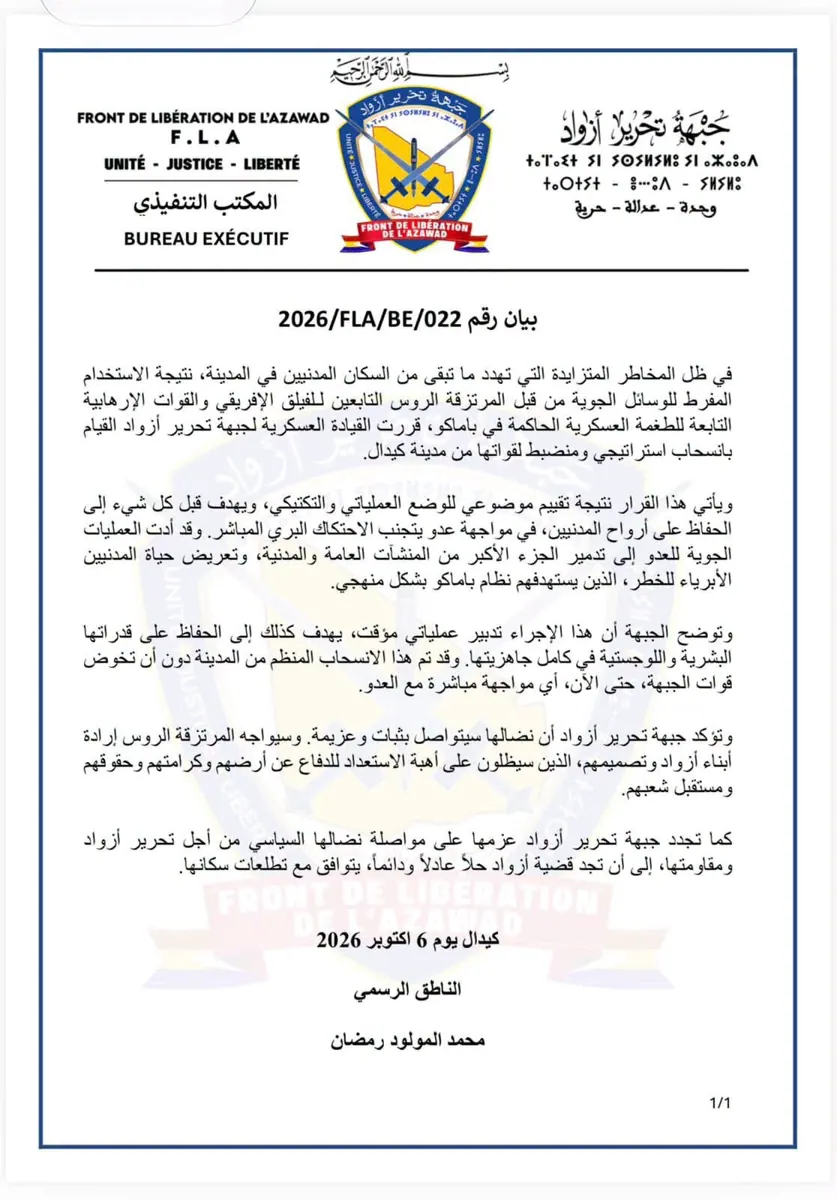
The Azawad Liberation Front announced on Tuesday a strategic and disciplined withdrawal of its forces from the city of Kidal. The group stated that the decision was made due to increasing risks to the remaining civilian population resulting from the excessive use of aerial means by the African Legion and Malian army. This move aims to preserve the lives of civilians in the face of an enemy that avoids direct ground contact.
According to the Azawad Liberation Front, the decision to withdraw came after a thorough evaluation of the operational and tactical situation. The group emphasized that its withdrawal was conducted without engaging in direct confrontations. The aerial operations of the enemy have led to the destruction of most public and civilian infrastructure, putting civilian lives at risk. The group views this withdrawal as a temporary operational measure to preserve its human and logistical capabilities.
The Azawad Liberation Front assured that its struggle will continue with determination and resilience. The group highlighted that its withdrawal was necessary to protect civilians from the escalating violence. The Malian army, supported by Russian allies, has been conducting airstrikes and ground operations in the Kidal region. The military reported significant casualties among armed groups in recent operations.
On Monday evening, the Malian General Staff announced that a large number of militants were killed in airstrikes and ground operations in the Kidal region. The military stated that precise strikes were carried out against armed group sites in Tinzouatine and its outskirts, resulting in the destruction of nearly ten pickup trucks, a truck, several motorcycles, and large quantities of equipment.
The Malian General Staff also reported that monitoring and reconnaissance operations are ongoing to assess the impact of the strikes accurately and prepare a final confirmed toll. The military aims to identify and neutralize any remaining threats. The situation in Kidal remains volatile, with ongoing clashes between the Malian army and armed groups.
The Azawad Liberation Front's withdrawal from Kidal raises concerns about the humanitarian situation in the region. The group has been a key player in the conflict, advocating for the independence of Azawad. The Malian government's efforts to regain control of the region have been met with resistance from armed groups.
The international community has been monitoring the situation in Mali, with some countries expressing concern about the escalation of violence. The United Nations has a peacekeeping mission in Mali, aimed at stabilizing the region and supporting the peace process. The situation in Kidal and the Azawad region remains a critical challenge for the Malian government and international stakeholders.
Key points
- The Azawad Liberation Front withdraws from Kidal due to increasing risks to civilians from aerial operations.
- The Malian army, supported by Russian allies, conducts airstrikes and ground operations in the Kidal region.
- The conflict in Kidal raises concerns about the humanitarian situation and the stability of the region.