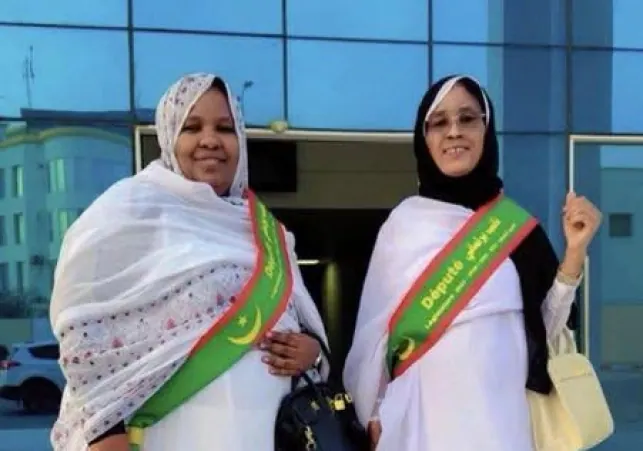
Ghamou Achour and Marième Dieng, two prominent figures in Mauritanian politics, have made history after being elected as deputies to the National Assembly in 2023 on the RAG/SAWAB list. However, their tenure was cut short after just three years, instead of the usual five, due to procedures marred by irregularities. Despite this, they refused to remain silent and continued to speak out against corruption, tribalism, and nepotism, confronting a government that has been accused of consolidating power.
The two deputies dominated the National Assembly with their passionate interventions, attacking a system where cowardice often prevails over courage. In today's Mauritania, it is often necessary to keep a low profile, avoid confrontation, and curry favor with those in power to avoid trouble. However, Ghamou Achour and Marième Dieng chose not to take this path, instead challenging the status quo and demanding accountability from those in power.
Their presence in the National Assembly was seen as a threat by those in power, and their interventions were often seen as uncomfortable. As a result, they were swiftly removed from their positions. However, their time in office was not without impact. They exposed weaknesses in the system, including the fact that decisions by the Constitutional Council, the highest regulatory body, can be rejected by Parliament.
The cases of Ghamou Achour and Marième Dieng have significant implications for the future of Mauritania's democracy. They highlighted the fact that a parliamentarian can be prosecuted and judged without the lifting of their parliamentary immunity. They also showed that the judiciary in Mauritania is beholden to the executive branch, raising concerns about the rule of law and the separation of powers.
The legacy of Ghamou Achour and Marième Dieng will be studied by scholars and researchers for years to come. Their cases will be used as a teaching tool in law faculties around the world, providing a valuable lesson in the importance of an independent judiciary and the protection of parliamentary immunity. Their courage and conviction have left a lasting impact on Mauritanian politics.
The two deputies' actions have also sparked a wider conversation about the state of democracy in Mauritania. Their determination to hold those in power accountable has inspired others to speak out against corruption and abuse of power. As Mauritania continues to navigate its complex political landscape, the examples set by Ghamou Achour and Marième Dieng will remain an important reference point.
In conclusion, Ghamou Achour and Marième Dieng have left an indelible mark on Mauritanian politics. Their bravery and commitment to democratic principles have inspired a new generation of politicians and citizens. As Mauritania looks to the future, their legacy will continue to shape the country's democratic development.
Key points
- The cases of Ghamou Achour and Marième Dieng highlight the importance of an independent judiciary and the protection of parliamentary immunity.
- The two deputies' actions have sparked a wider conversation about the state of democracy in Mauritania.
- Their legacy will continue to shape Mauritania's democratic development for years to come.