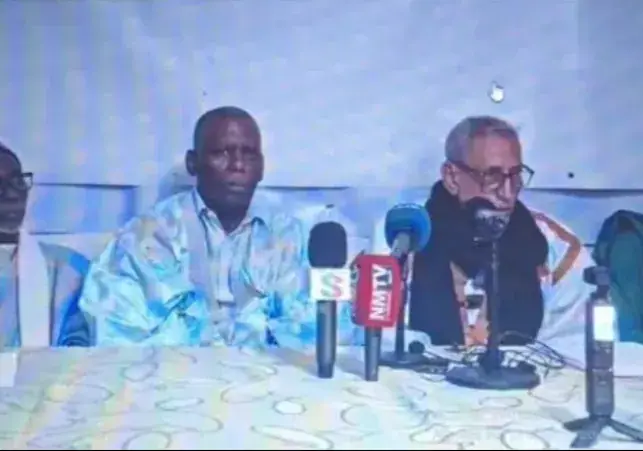
On November 17, 2026, the Coalition for a Peaceful Democratic Alternative in 2029 (CADP 2029) held a press conference at the AJD/MR headquarters in Nouakchott, Mauritania, to address the issue of linguistic exclusion. The coalition, comprising various political parties and movements, released a statement advocating for a united Mauritania where no language is used to exclude citizens. The statement criticized the recent circular by the Minister of Culture, which they claim promotes the use of Arabic to the exclusion of other national languages.
The CADP 2029 coalition argues that the push for Arabic as the sole language in government departments and workplaces would unfairly disadvantage citizens who are proficient in other languages, such as French, Pulaar, Soninke, and Wolof. They contend that this approach would limit access to employment and promotion for certain groups, effectively creating a linguistic barrier. The coalition emphasizes that the Mauritanian Constitution guarantees equality before the law for all citizens, regardless of origin, and recognizes the importance of preserving and promoting all national languages.
The coalition also criticized those who claim to defend national languages but have not actively supported their official recognition. They pointed out that some proponents of exclusive Arabic use send their own children to French-language schools, often abroad, highlighting the hypocrisy in their stance. The coalition argues that French, as a working language, has been instrumental in educating and preparing generations of Mauritanian professionals who have served the country loyally.
The CADP 2029 coalition is calling for several key measures to address linguistic exclusion and promote equality. These include the withdrawal of any measures that use language as a means of exclusion or discrimination, the official recognition of Pulaar, Soninke, and Wolof, and the development of a program for linguistic training for state agents supported by modern translation tools. They also advocate for a national consultation on language policy and its implementation.
The coalition's statement highlights the need for a united and inclusive Mauritania, where all languages are valued and recognized. They argue that in today's era of advanced technology, where instant translation is possible, using language as a tool for division is outdated and detrimental to national cohesion. The coalition's demands aim to ensure that all citizens have equal access to opportunities and can participate fully in the country's development.
The press conference and subsequent statement by CADP 2029 reflect a broader debate in Mauritania about language, identity, and inclusion. The issue has sparked significant reactions, with some accusing the coalition of promoting division and others supporting their call for linguistic equality. The Mauritanian government has not yet responded to the coalition's demands, but the issue is likely to remain a contentious topic in the country's ongoing discussions about national identity and development.
The CADP 2029 coalition comprises a diverse group of political parties and movements, including the Rally for Democratic Progress (RDP), the Mauritanian People's Congress (FPC), and the Initiative for the Resurgence of the Abolitionist Movement (IRA). The coalition's leaders, including Youssef Issa, Samba Thiam, and Biram Dah Abeid, have called for unity and inclusivity in Mauritania, emphasizing that the country's future depends on its ability to recognize and value its linguistic diversity.
Key points
- The coalition demands the official recognition of Pulaar, Soninke, and Wolof, along with a program for their teaching at all levels.
Reporting sources
- Déclaration pour une Mauritanie unie : contre l’exclusion linguistique et pour l’égalité des langues · L'Authentique (Mauritania)