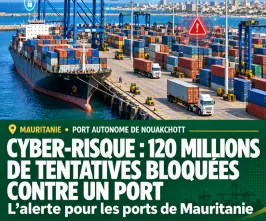
The Port of Los Angeles in the United States reported blocking over 120 million cyberattacks in August, including attempts at intrusion, network exploitation, and malware. This incident highlights the growing threat of cyberattacks on critical infrastructure, particularly ports. As a vital component of Mauritania's economy, the Port Autonome de Nouakchott must take steps to protect itself from similar threats. The port is a strategic entry point for imports, equipment, and essential goods.
The Port Autonome de Nouakchott, also known as the Port of Friendship, plays a central role in Mauritania's economy. It is a key hub for commercial exchanges with regional and international partners. The port's modernization and digitalization efforts have increased efficiency, transparency, and speed, but have also created new vulnerabilities to cyber threats. A successful cyberattack on the port could have far-reaching consequences, including delays, logistical disruptions, and financial losses.
A cyberattack on a port can have significant economic impacts, including delayed processing of ships, disrupted cargo management, and blocked customs procedures. In a country where the port plays a crucial role in national supply chains, a major cyber incident could have cascading effects, including shortages, logistical surcosts, and damage to the country's reputation. The risk of cyberattacks must be treated as an operational, financial, logistical, and reputational risk.
The threat of cyberattacks on the Port Autonome de Nouakchott does not only come from the central system, but also from compromised user accounts, stolen passwords, phishing messages, and insecure remote access. To build cyber resilience, the port must adopt a comprehensive approach that involves not only the IT team but also the general management, operational teams, security, risk management, and logistics partners.
To strengthen its cyber resilience, the Port Autonome de Nouakchott should prioritize several key areas, including identifying critical digital and operational systems, mapping dependencies on technological and logistical suppliers, and reinforcing identity and access management. The port should also ensure continuous monitoring of security events, regular testing of business continuity plans, and integration of cybersecurity requirements into contracts with suppliers.
Cooperation and information sharing are essential in building cyber resilience. A structured mechanism for sharing information on threats between the port, competent administrations, private operators, and security partners would improve early detection and collective response. Developing national skills in maritime and industrial cybersecurity is also crucial.
The cyber resilience of the Port Autonome de Nouakchott is a matter of economic sovereignty for Mauritania. As the country continues its modernization and economic development efforts, protecting critical infrastructure such as the port is essential. The example of the Port of Los Angeles serves as a warning, highlighting the need for preparedness and resilience in the face of growing cyber threats.
Key points
- The Port Autonome de Nouakchott must adopt a comprehensive approach to build cyber resilience.
- The port should prioritize identifying critical digital and operational systems and reinforcing identity and access management.
- Cooperation and information sharing are essential in building cyber resilience.