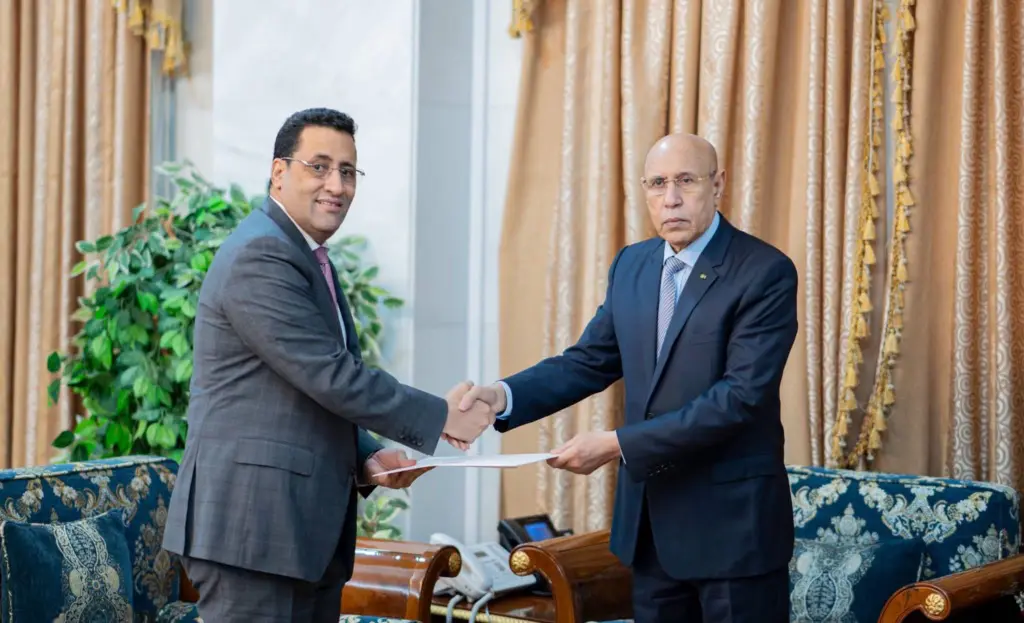
Mauritania has entered a new phase of government with the reconfirmation of Mokhtar Ould Diay as Prime Minister and the formation of a new team consisting of 29 ministers and ministers-delegated. The new government combines the maintenance of certain officials in their positions, the transfer of others between different sectors, and the allocation of sensitive portfolios to returning or new personalities. This configuration suggests a desire to renew action while ensuring continuity on a number of essential files.
The new government is set against a backdrop of pressure for improved public services, following the electricity crisis and technical and administrative irregularities revealed by the investigation into the fires at two Nouakchott transformation posts. The government's composition extends beyond this issue, with changes in the economic, social, and administrative sectors. Three clear priorities have been announced: strengthening social protection, training, employment, and youth empowerment, as well as developing cities and interior regions.
The reconfirmation of Ould Diay as Prime Minister after his government's resignation demonstrates a renewal of presidential confidence in his leadership of the executive. This offers him the opportunity to continue implementing the "Ambitious for the Nation" program with a team in which responsibilities have been redistributed. However, it also strengthens his obligation to be held accountable politically for the results obtained. The maintenance of the Prime Minister in his position makes this new phase an extension of his experience in power.
The reshuffle within the Ministries of Defense and Interior appears to be one of the main lines of this government. The Ministry of Defense, Veterans, and Martyrs' Children has been entrusted to Ba Ousmane, while Mokhtar Ould Ahmed Bouceif has taken the helm of the Ministry of Interior, Decentralization, and Local Development. In contrast, Mohamed Salem Ould Merzoug retains the Foreign Affairs portfolio, and Mohamed Ould Soueïdatt, the Justice portfolio.
On the economic front, the government has reconfirmed Codioro Moussa N’Guenore as Minister of Finance and entrusted economic affairs and development to Mohamedou Ould M’Haimid, who was previously Minister of Agriculture. This composition combines continuity in public finance management with a change in development policy leadership. The challenge facing both ministers will be to balance the financing of social priorities and projects, controlling spending, and accelerating implementation.
In the energy and oil sector, Mohamed Abdel Fattah has been entrusted with a portfolio that is the subject of particular public attention. The ministry's challenge will not be limited to ensuring supply security but will also include facility security, preventive maintenance, network reliability, and contract execution control. Given the electricity crisis, service stability will be one of the most immediate indicators by which citizens will assess the government's seriousness and the administration's ability to capitalize on the investigation's findings.
The government's social priorities are reflected in the appointments of Naha Hamdi Mouknass as Minister of Health, Amal Mouloud as Minister of Hydraulics and Sanitation, and Houda Babah as Minister of Education and Educational Reform. The maintenance of these ministers offers the opportunity to continue ongoing programs, but coordination between education, training, and employment is imperative. The real test lies in the ability of training to lead to real and sustainable job opportunities.
Key points
- The new government must address the electricity crisis and improve public services.
- The government's composition reflects a desire to renew action while ensuring continuity on essential files.
- The reconfirmation of Ould Diay as Prime Minister strengthens his obligation to be held accountable for the results obtained.