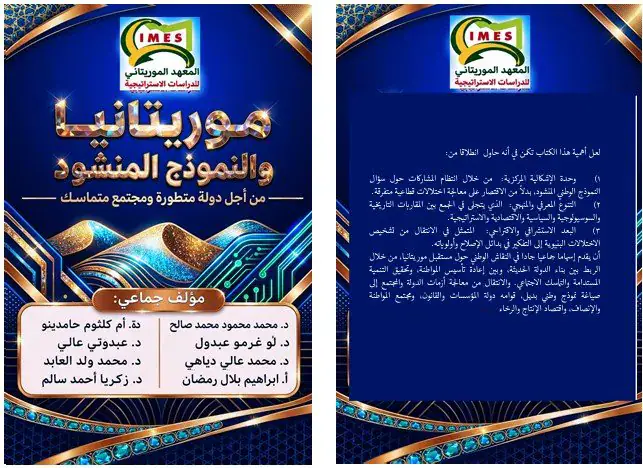
The Mauritanian Institute for Strategic Studies has released a collective work titled "Mauritania and the Aspired Model: Towards a Developed State and a Cohesive Society". This work is a compilation of contributions from various authors, including Dr. Mohamed Mahmoud Mohamed Saleh, Dr. Lo Gremmo Abdoul, and Dr. Mohamed Ali Diaby, among others. The book seeks to redefine the country's development model and provide a comprehensive framework for a modern state.
The collective work goes beyond mere reform proposals and instead focuses on the fundamental question of the type of state Mauritanians want. It aims to create a state that derives its strength from social legitimacy, effective institutions, and the ability to guarantee justice, equality, and fairness for all citizens. The authors emphasize that stability and development cannot be achieved without institutions that enjoy societal trust.
The work proposes a shift from a state that has not yet completed its institutional and national integration to a modern state in the full sense of the word. The authors agree on the importance of a productive economy, fair policies, and equal citizenship. They stress that the country's sovereignty can only be complete with a state capable of managing its strategic interests and anticipating its environment.
The book aims to move the national debate from piecemeal reforms to a discussion of the model that should underpin these reforms. It advocates for a model that combines strength and justice, unity and recognition of diversity, resource exploitation, and productive economy. The authors also emphasize the need for a state that can ensure internal stability and strategic independence.
The collective work seeks to redefine the relationship between the state and society on more just, credible, and inclusive grounds. It proposes a model where citizenship is the basis of belonging, the law regulates relationships, and institutions serve the public interest. The authors aim to create a society where development is a means of improving the lives of all citizens.
The work provides a comprehensive approach to transforming Mauritania's economy from a rent-based economy to one that creates wealth and provides job opportunities. It also seeks to shift the country from a reality-based coexistence to a citizenship-based model that is grounded in equal rights and duties. The authors emphasize the need for a deep-seated trust between society and the state.
The book "Mauritania and the Aspired Model" represents a significant contribution to the country's development discourse. It provides a framework for a comprehensive national project that can unite Mauritanians around a shared vision for the future. The work's recommendations and ideas are expected to inform policy decisions and shape the country's development trajectory in the years to come.
Key points
- The collective work provides a comprehensive framework for a modern state that prioritizes social legitimacy, effective institutions, and economic productivity.