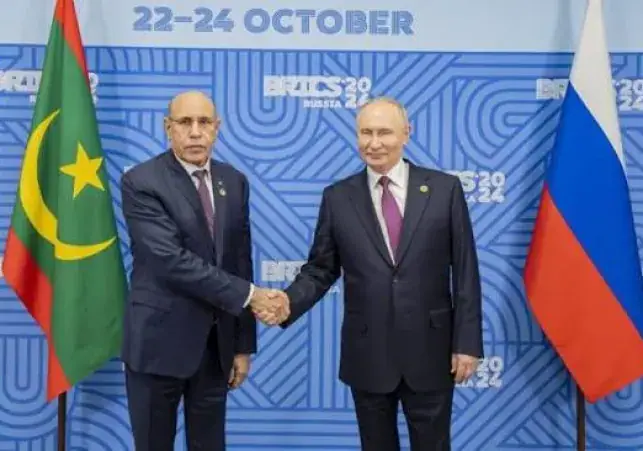
President Mohamed Cheikh Ghazouani of Mauritania participated in the 3rd Russia-Africa Summit held in Moscow on October 28-29, 2026, alongside other African heads of state and high-level delegations. He was accompanied by the Minister of Foreign Affairs and the Minister of Justice. The summit, themed "For Peace, Security, and Development," discussed various topics, including economy, commerce, investments, infrastructure, and digital transformation with Russian President Vladimir Putin and his officials.
The summit saw the signing of 146 bilateral agreements between Russia and several African countries in key areas such as military security, nuclear energy, mining, and infrastructure development. However, the Mauritanian delegation's outcomes were notably limited. They secured a cooperation agreement on extradition and transfer of convicted individuals and a deal in the public media sector. Critics argue that these agreements do not significantly benefit the country or its population.
In contrast to Mauritania's modest gains, many African nations utilized the summit to secure substantial partnerships. Forty-five nations reaffirmed their military and defense partnerships with Russia, including in training. Countries like Burkina Faso, Mali, and Morocco signed long-term agreements with Rosatom for civilian nuclear energy, enhancing their national energy capacities. Mauritania missed opportunities to diversify its partnerships, particularly in military equipment and major armament systems.
The limited scope of Mauritania's agreements with Russia has been attributed to its existing advanced cooperation with NATO and the Western bloc, particularly the United States. The US would likely oppose Mauritania engaging with Russian military or paramilitary groups. Experts suggest that Mauritania could have benefited from engaging with Rosatom for nuclear energy deals or collaborating with Russian giants like Zarubezhgeologia in geological mapping and mining.
The Mauritanian delegation's priorities have been questioned, given the country's needs. While extradition and media cooperation may be important, they seem to overshadow more pressing issues like energy, mining, and infrastructure development. Neighboring countries have successfully leveraged Russian partnerships to boost their economic and military capabilities, raising questions about Mauritania's strategy.
Critics argue that Mauritania's approach to the Russia-Africa Summit was too narrow and missed significant opportunities for strategic partnerships. By not engaging with major Russian companies like Alrosa or Rusal in the mining sector, Mauritania may have limited its potential for economic growth and development. The country's delegation has been urged to reassess its priorities and seek more substantial collaborations with Russia.
The outcome of the Russia-Africa Summit for Mauritania has sparked a national conversation about the country's foreign policy and economic strategy. As the country seeks to develop its economy and improve living standards, questions have been raised about the effectiveness of its diplomatic efforts and the need for more ambitious partnerships with international partners, including Russia.
Key points
- Mauritania's limited agreements with Russia at the summit have been criticized as insufficient.
- The country's existing cooperation with NATO and the Western bloc may have limited its ability to engage with Russia.
- Mauritania missed opportunities to secure partnerships in key sectors like nuclear energy, mining, and military equipment.