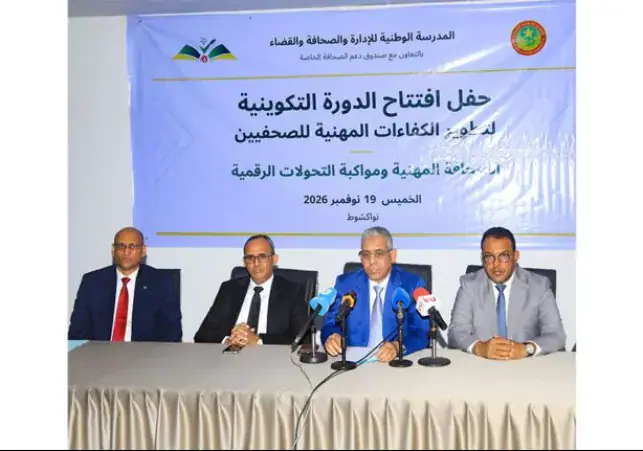
The Mauritanian Culture Minister, Mohamed Ould Babana, has inaugurated a two-week training session for 100 journalists in Nouakchott. The session, organized by the National School of Administration, Journalism, and Magistracy, in collaboration with the Public Support Fund for Private Press, focuses on professional journalism in the digital age. Journalists working in Arabic, Wolof, Pulaar, and Soninke, as well as regional press representatives and public media technicians, are participating in the session.
Minister Ould Babana emphasized that investing in the media sector begins with journalist qualification, competency reinforcement, and capacity building to access, process, and present information professionally and responsibly. He highlighted the importance of this session, which offers participants the opportunity to benefit from specialists' expertise in various journalistic genres and practices. The minister also stressed that press freedom consolidates through professionalism, which is rooted in knowledge and continuous training.
The training session aims to reform and develop the national media landscape, in line with President Mohamed Ould Cheikh El Ghazouani's program. The minister reviewed the main reforms undertaken in the media sector, including legal and institutional improvements, better working conditions, and the development of public media institutions. He mentioned that over 1,800 collaborators' situations had been regularized. The minister also emphasized the need for human resource qualification, content quality improvement, and regional press development.
Mohamed Yahya Ould Said, Director-General of the National School of Administration, Journalism, and Magistracy, stated that continuous training is essential for professionalization and improving daily journalistic practices. He explained that the session's theme reflects the importance of following digital transformations and leveraging new tools for research, verification, and content production while considering increased professional responsibilities.
The session will cover various topics, including journalistic ethics, writing techniques, regulatory texts, investigative journalism, data journalism, digital journalism, artificial intelligence, online information verification, and combating disinformation. The training also focuses on regional press, proximity media, and local development issue coverage. The opening ceremony was attended by the President of the High Authority of Press and Audiovisual and the Deputy Director-General of the National School of Administration, Journalism, and Magistracy.
Mohamed Ould Abidine, President of the Fund's Management and Distribution Commission, presented the 2025 report on public support for private press. He stated that 296 press enterprises and organizations benefited from support, including 220 electronic sites, 31 newspapers, 10 audiovisual channels, and 29 press organizations. The Fund contributed to covering 60-80% of regular newspaper printing costs, supporting international subscriptions, and providing social assistance to journalists.
The training session is a significant step towards enhancing journalistic skills and promoting press freedom in Mauritania. With the country's media landscape evolving, such initiatives aim to ensure that journalists are equipped to navigate the challenges of the digital age while upholding professional standards. Key developments in the media sector include improved working conditions, institutional reforms, and increased support for regional press.
Key points
- The training session focuses on professional journalism in the digital age.
- 100 journalists from Mauritania are participating in the two-week session.
- The initiative aims to reform and develop the national media landscape.
Reporting sources
- Le ministre de la Culture préside l’ouverture d’une session de formation au profit de 100 journalistes · L'Authentique (Mauritania)