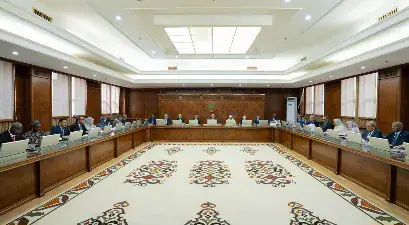
On November 4, 2026, Mauritania's Council of Ministers convened under the leadership of President Mohamed Ould Cheikh El-Ghazouani. During the meeting, several crucial decrees were examined and adopted. These decrees aim to reform various sectors, including public procurement, customs, higher education, and key national appointments. The Council's decisions are expected to have a significant impact on the country's governance and development.
One of the key decrees adopted is related to the implementation of the 2026 law on public procurement. This decree aims to align Mauritania's public procurement framework with international best practices. It establishes the Autorité de Régulation de la Commande Publique, the Commission de Contrôle de la Commande Publique, and the Commissions de Passation des Marchés Publics. These institutions will be equipped with the necessary tools and resources to ensure effective public procurement management.
The decree on public procurement also focuses on professionalizing and strengthening the accountability of public procurement actors. This will be achieved through regular certification and performance monitoring of various market commissions. Additionally, the decree aims to promote good governance and transparency by reducing corruption risks. This will be done through asset and interest declarations, as well as the gradual digitalization of public procurement procedures.
Another decree adopted by the Council modifies certain provisions of the decree on the particular status of customs. This decree corrects and complements provisions related to human resource management, including initial training, evaluation of allowances, reserve placement, and retirement. The goal is to ensure coherence with corresponding regimes in other military, paramilitary, and security corps.
The Council also adopted a decree establishing a unified particular status for higher education teachers and researchers. This decree aims to modernize and unify the statutory framework applicable to higher education teachers and researchers. It also seeks to harmonize career management rules, strengthen academic qualification as a determining element of recruitment and advancement, and clarify professional rights and obligations.
In addition to these decrees, the Council made several key appointments. These include the appointment of the President of the Board of Directors of the Mauritanian Hydrocarbons Company (SMH), the President and members of the Board of Directors of the Mauritanian Maritime Affairs Agency (AMAM), and the President and members of the Board of Directors of the National Public Works Laboratory (LNTP).
The Prime Minister presented a communication on the main lines of the government's general policy, which will be submitted to the National Assembly. The Ministers of Foreign Affairs, Interior, and others also presented communications on international, interior, and other situations.
Key points
- The Council of Ministers adopted several key decrees aimed at reforming public procurement, customs, and higher education.
- The decrees aim to promote good governance, transparency, and accountability in various sectors.
- The Council also made several key appointments to national institutions.