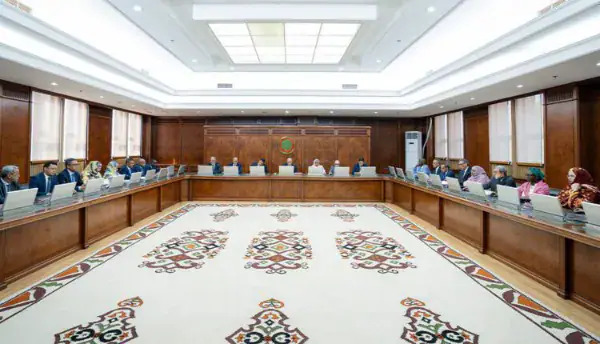
The Council of Ministers of Mauritania convened on November 18, 2026, under the leadership of President Mohamed OULD CHEIKH EL-GHAZOUANI. During the meeting, they examined and adopted several key projects aimed at modernizing and developing various sectors in the country. These projects included laws and decrees related to the craft sector, education, pharmaceuticals, and mining.
One of the significant decisions made was the adoption of a law that repeals and replaces the 2003 law on the craft code. This new law aims to modernize the organization of the craft sector, clarify the legal status of its actors, and support its economic development. The law defines craft activities and professional statuses, simplifies the sector's organization, and regulates the exercise of the profession.
The law also provides for the creation of a Fund to support the craft sector, which will finance actions to promote and develop the sector. Additionally, it establishes a system to control the sector, with authorized agents to exercise control missions, define infractions, and apply sanctions. The law allows for a three-year period for artisans and craft enterprises already in operation to regularize their situation.
The Council of Ministers also adopted a decree reorganizing the University of Islamic Sciences, transforming it into a more comprehensive and multidisciplinary University of Aïoun. This decree modernizes the university's governance, expands its training offer beyond Islamic sciences, and organizes its administrative and financial autonomy.
In the pharmaceutical sector, the Council adopted two decrees. The first decree regulates the promotion of medicines, advertising, and the modalities for obtaining authorizations for medical information and promotion activities. The decree aims to ensure that information on medicines is accurate, balanced, and compliant with market authorization data.
The second decree regulates the manufacture, importation, storage, distribution, dispensing, and quality control of cosmetic and body hygiene products. This decree establishes a system of cosmetic vigilance to monitor and notify serious adverse effects. It also sets conditions for the fabrication, importation, and distribution of these products.
Finally, the Council of Ministers adopted a decree granting twenty-five research permits for substances in group 2 to mining companies. This move is part of the efforts to modernize and clean up the mining cadastre, resolve pending cases, and improve the processing of mining title requests.
Key points
- The Council of Ministers adopted a new law to modernize the craft sector in Mauritania.
- A decree was adopted to reorganize the University of Islamic Sciences into a more comprehensive University of Aïoun.
- Two decrees were adopted to regulate the pharmaceutical sector, including the promotion of medicines and the control of cosmetic products.
Reporting sources
- Communiqué du Conseil des Ministres n° 34/2026 du 18 novembre 2026 · Journal Tahalil