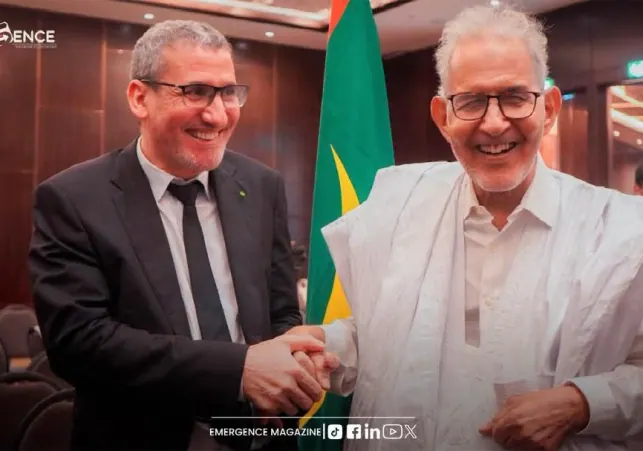
The Central Bank of Mauritania (BCM) recently presented a book titled "A History of Money in Mauritania" in Nouakchott, which chronicles the evolution of the country's national currency, the ouguiya. The book, authored by anthropologist Abdel Wedoud Ould Cheikh and expert-comptable Mohamed Fall Ould Bah, was launched on the sidelines of the 20th annual meeting of the Group of Directors of Training for Francophone Central Banks. The event was attended by BCM Governor Mohamed Lemine Dhehby and other officials.
The book provides an in-depth analysis of Mauritania's monetary history, dating back to the trans-Saharan and Atlantic trade era. It highlights the country's integration into the French monetary sphere during the colonial period and its subsequent transition to independence. The authors detail the process that led to Mauritania's exit from the West African Monetary Union and the French franc zone in 1973, resulting in the creation of the ouguiya. The book also examines the challenges faced by the country during this transition and the role played by the central bank in establishing monetary sovereignty.
The ouguiya was introduced into circulation on June 29, 1973, replacing the CFA franc at a rate of one ouguiya to five francs. The BCM was established in the same year to oversee the issuance of the new currency. The book offers a comprehensive overview of the institution, its internal workings, and its contribution to the country's economic development over the years. The authors, both renowned experts in their fields, bring a unique perspective to the narrative, drawing on their extensive research and knowledge of Mauritanian history and culture.
The book's launch in Mauritania marks an important milestone in the country's efforts to document and preserve its monetary and institutional history. According to the BCM, the publication aims to provide a reference work for the public and researchers, particularly at a time when the stability of the ouguiya and reserve management are at the forefront of economic debates. The book is already available in French bookstores, priced at 30 euros.
During the book launch, Ahmed Ould Daddah, the first governor of the BCM, revealed that the enigmatic "Old Sage" featured on Mauritanian banknotes since 1974 was not a specific individual, but rather an anonymous representation of the Mauritanian people. The image, which had sparked much speculation over the years, was actually a portrait discovered by Ould Daddah in Gorée, painted by French artist Myrto Debard. The image was chosen to represent the nation without being associated with a particular region, ethnicity, or tribe.
Myrto Debard, a French painter who spent much of her life in Gorée, was known for her depictions of Saharan landscapes and people. Her work was influenced by her travels to Niger, Mali, and Mauritania, where she exhibited her art in Nouakchott. The portrait of the "Old Sage" is a testament to her artistic legacy and the cultural exchange between France and Mauritania.
The book on Mauritania's monetary history is a significant contribution to the country's cultural and economic heritage. By chronicling the evolution of the ouguiya and the central bank's role in shaping the country's monetary policy, the authors provide a valuable resource for researchers, policymakers, and the general public. The publication also underscores the importance of preserving and promoting Mauritania's history and culture, both domestically and internationally.
Key points
- The Central Bank of Mauritania has published a book on the history of the national currency, the ouguiya, and its independence from the French franc zone.
- The book, authored by Abdel Wedoud Ould Cheikh and Mohamed Fall Ould Bah, provides an in-depth analysis of Mauritania's monetary history and the challenges faced during the transition to independence.
- The publication aims to document and preserve Mauritania's monetary and institutional history, providing a reference work for the public and researchers.