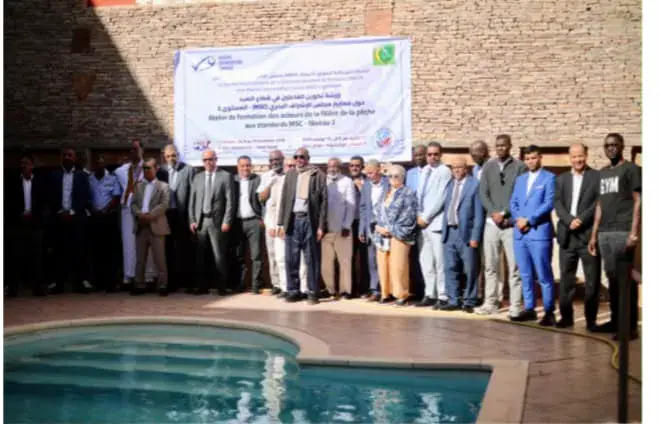
The Mauritanian Fish Marketing Company, in collaboration with the Marine Stewardship Council (MSC), launched the workshop, which is the first of its kind in Mauritania. The event brings together 25 participants from the fishing sector, representing government agencies, non-governmental environmental organizations, and the private sector. The workshop aims to enhance national capacities and expertise in sustainable fisheries management, aligning with the country's strategic goals and the vision of President Mohamed Ould Ghazouani.
The workshop's opening session was addressed by Yerb El-Man Aemin, General Manager of the Mauritanian Fish Marketing Company. He emphasized the strategic importance of sustainable fisheries management, highlighting its role in preserving the country's fish resources and maximizing their economic benefits. Aemin also stressed the company's commitment to meeting international market requirements, which have high environmental standards, while maintaining the vital role of the octopus fishery in providing livelihoods for thousands of Mauritanian families and supporting the national economy in the long term.
Dr. Hamoud Al-Fazl, Technical Advisor to the Octopus Fishery Improvement Project at the Mauritanian Fish Marketing Company, noted that the octopus fishery holds significant strategic importance for Mauritania. The fishery contributes to the national economy and provides livelihoods for people, particularly in coastal areas. With increasing international market demand for seafood products from sustainably managed fisheries, obtaining MSC certification for Mauritanian octopus is a key project objective. The project works with producers, exporters, researchers, and public authorities to ensure the long-term sustainability of this resource.
The workshop will enable Mauritanian stakeholders to acquire the necessary knowledge to continue efforts to improve the performance of the octopus fishery. Participants will be trained on the MSC standard, a globally recognized benchmark for sustainable fisheries management. They will learn about the practical application of these principles through technical presentations, case studies, and exercises, allowing them to assess fishery performance, understand performance indicators and evaluation requirements, and prioritize improvements.
Sheikh Abdullah Inge, MSC Advisor for Fisheries Outreach in West Africa, emphasized that building local technical capacities is crucial for promoting sustainable fishing in the region. Deepening participants' understanding of the MSC standard and sustainability tools will enable them to translate acquired knowledge into practical actions, ensuring that expertise remains in the region and supports sustainable improvements beyond the workshop.
The workshop is part of the MSC's global capacity-building program, tailored to support stakeholders involved in the Mauritanian Octopus Fishery Improvement Project (FIP). This multi-stakeholder initiative aims to improve the environmental performance of the fishery and enhance its management. Participants will learn about the MSC standard, which focuses on maintaining healthy fish stocks, minimizing fishing impacts on the marine environment, and adopting effective fisheries management.
The five-day workshop will equip participants with the knowledge and skills necessary to contribute to the sustainable management of Mauritania's fisheries resources. By enhancing national capacities and expertise, the workshop supports the country's efforts to promote sustainable fishing practices, maintain healthy fish stocks, and maximize the economic benefits of its fisheries resources.
Key points
- The workshop aims to enhance national capacities and expertise in sustainable fisheries management.
- The event is part of the MSC's global capacity-building program.
- The workshop supports the Mauritanian Octopus Fishery Improvement Project, a multi-stakeholder initiative to improve the environmental performance of the fishery.