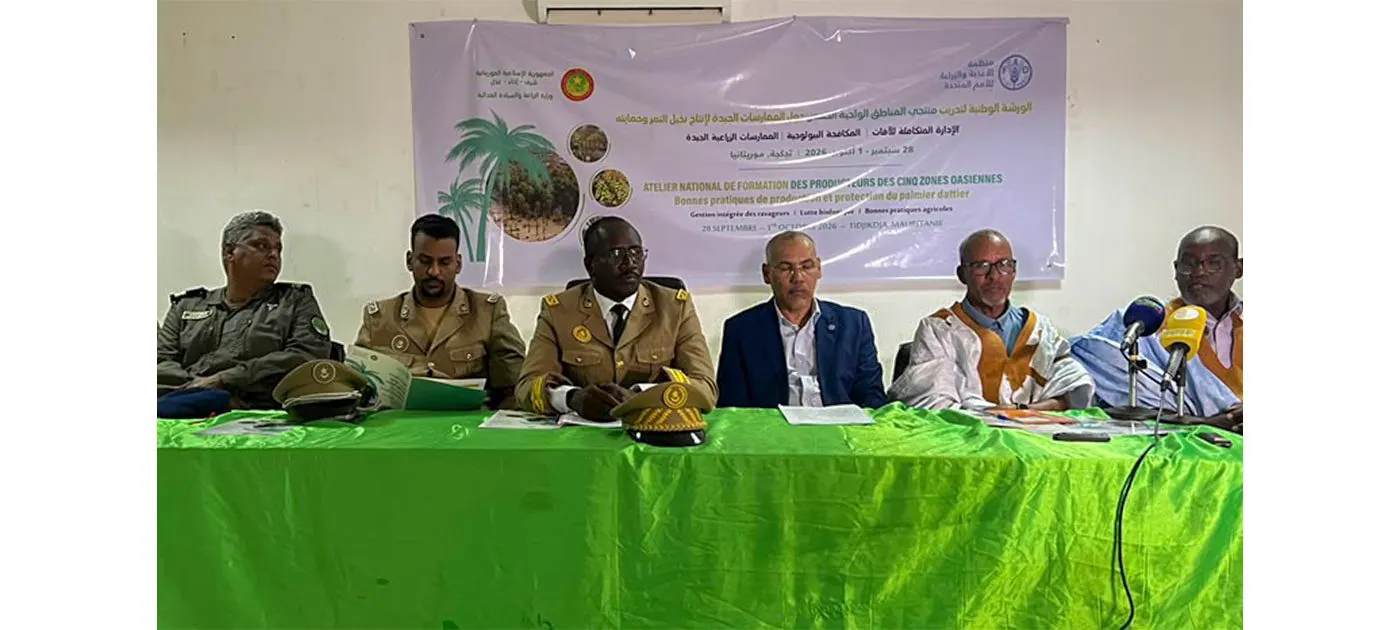
The workshop, organized by the Mauritanian Ministry of Agriculture and Food Sovereignty in collaboration with the Food and Agriculture Organization (FAO) of the United Nations, brings together producers from the oases regions of Tiris Zemmour, Adrar, Assaba, and the two Hodh regions. In his opening speech, the Governor of Tiris Zemmour, Ahmed Mamadou Kley, emphasized the importance of hosting the workshop in Tidjikja, given the significant role palm trees play in the country's agricultural system and the economic, social, and cultural value of the oases.
The workshop aligns with the high-level directives of President Mohamed Ould Cheikh El Ghazouani, who during his recent visit to Tiris Zemmour, stressed the need to develop the agricultural sector, valorize local resources, and promote sustainable development in the oases regions. The Governor of Tiris Zemmour and other officials, including the Deputy President of the Tiris Zemmour region and the Mayor of Tidjikja, welcomed the workshop, expressing hope that its outcomes would enhance the expertise of those involved in palm tree development.
The Assistant Director of Plant Protection at the Ministry of Agriculture and Food Sovereignty, Mohamed Sidena Ali Sghair, explained that the workshop aims to strengthen the capacities of producers and technicians in good agricultural practices, plant health monitoring, and integrated pest management. The workshop also seeks to encourage the exchange of experiences among producers, technicians, and institutional stakeholders on sustainable control methods and conservation of oasis ecosystems.
The FAO's Subregional Office for North Africa's Plant Production and Protection Officer, Mohamed Hadi Sidatt, noted that the workshop is not just a training session but a discussion on the future of oases and sustainable production. He highlighted that Mauritania's oases represent a unique agricultural and environmental system, with approximately 2.6 million palm trees and an annual production of around 24,000 tons of dates.
Sidatt emphasized that palm trees play a vital role in the country's ecosystem, serving as a source of food, income, and protection for the soil. However, he warned that these systems face increasing challenges, including pests, diseases, poor agricultural practices, water scarcity, and climate change. He cited the successful experience of controlling the red palm weevil in Tidjikja in 2015 as an example of the importance of early detection and integrated control.
The workshop was attended by various officials, including the Assistant Governor of Tidjikja, Harter Ahmed Salem El Keihl, and representatives from the Ministry of Agriculture and Food Sovereignty, as well as security and military leaders in the region. The event aims to promote sustainable palm tree production and enhance the livelihoods of communities in Mauritania's oases regions.
Key points
- The workshop seeks to enhance the skills of palm tree producers in Mauritania's oases regions.
- The event is organized by the Mauritanian Ministry of Agriculture and Food Sovereignty in collaboration with the FAO.
- The workshop aims to address challenges facing palm tree production in Mauritania, including pests, diseases, and climate change.