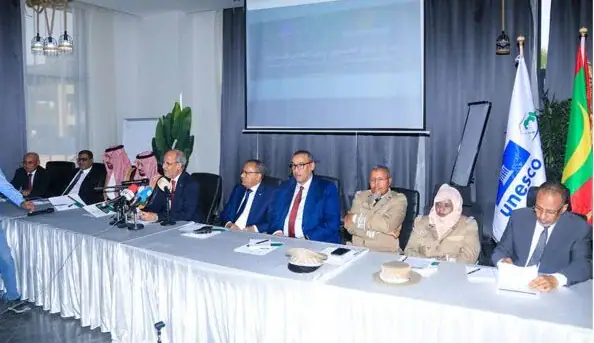
The Mauritanian capital, Nouakchott, recently hosted a high-level meeting to launch a strategic partnership between the Ministry of Vocational Training, Craftsmanship, and Trades and UNESCO's Regional Centre for Quality and Excellence in Education. This cooperation aims to upgrade the country's vocational training system, improve its quality standards, and align its curricula with labor market demands. The meeting was attended by several government officials, sectoral experts, private sector representatives, and the Saudi ambassador to Mauritania.
The partnership seeks to address the challenges facing Mauritania's vocational training sector, including the need to update the national strategy, align training with economic needs, and strengthen institutional governance. The country's Minister of Vocational Training, Mohamed Malainine Ould Eyih, emphasized the importance of vocational training in socio-economic development, youth employability, and workforce qualification. He expressed his conviction that cooperation with UNESCO will enable the development of a comprehensive sectoral diagnosis and a pragmatic operational plan.
UNESCO's Regional Centre Director, Abdulrahman Al-Madairis, highlighted the four pillars of the Arab model for quality, which can be adapted to Mauritania's specific context. He stressed the need for rigorous planning, performance indicators, and monitoring to ensure the reforms' concrete impact on the ground. Al-Madairis reaffirmed his institution's commitment to mobilizing technical expertise in support of Mauritania's youth and development.
The partnership launch event was attended by several high-ranking officials, including the Minister of Economic Affairs and Development, Mohamedou Ahmedou M'Haimid, and the Minister of Higher Education and Scientific Research, Yacoub Ould Moine. The Saudi ambassador to Mauritania, Dr. Abdelaziz ben Abdallah Al-Roukaïbi, was also present. The meeting brought together sectoral experts, private sector representatives, and other stakeholders to discuss the partnership's objectives and implementation.
The strategic partnership between Mauritania's Ministry of Vocational Training and UNESCO's Regional Centre aims to improve the quality and relevance of vocational training in the country. By modernizing the vocational training system, the partnership seeks to enhance youth employability, address labor market needs, and contribute to Mauritania's socio-economic development. The partnership will focus on developing a comprehensive sectoral diagnosis, designing a pragmatic operational plan, and implementing reforms.
The Arab model for quality, which will be adapted to Mauritania's context, focuses on four key areas. These areas include developing a quality management system, improving teaching and learning processes, enhancing the relevance of vocational training programs, and strengthening institutional capacities. By implementing this model, Mauritania aims to improve the quality and effectiveness of its vocational training system.
The partnership between Mauritania and UNESCO reflects the country's commitment to improving its vocational training system and addressing the needs of its youth and labor market. By leveraging UNESCO's technical expertise and international best practices, Mauritania aims to develop a modern, effective, and relevant vocational training system that contributes to the country's socio-economic development and growth.
Key points
- The partnership aims to modernize Mauritania's vocational training system and align it with labor market demands.
- The partnership will focus on developing a comprehensive sectoral diagnosis and designing a pragmatic operational plan.
- The Arab model for quality will be adapted to Mauritania's context to improve the quality and effectiveness of its vocational training system.