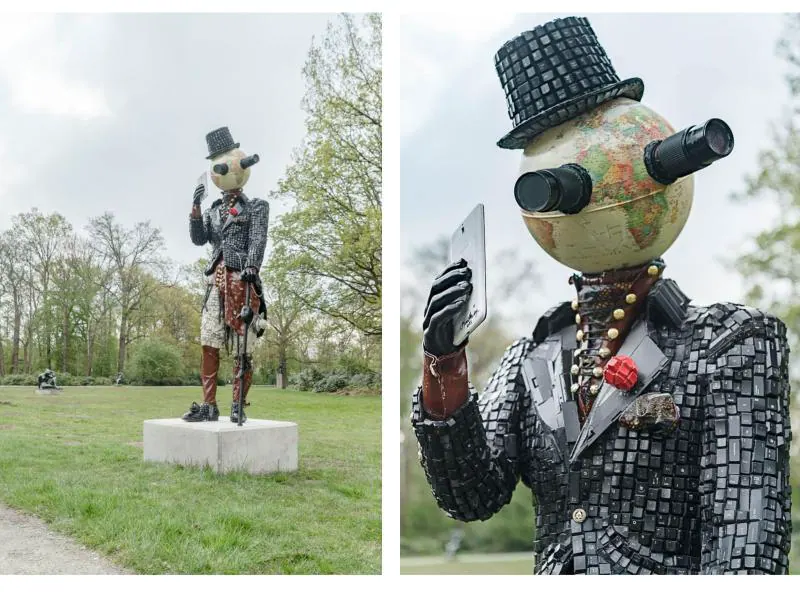
Born in the Democratic Republic of Congo, Maurice Mbikayi has been developing his multidisciplinary artistic practice since 2010, combining sculpture, installation, performance, and photography. Through electronic waste and discarded technology, he examines the transformations of identity, work, memory, power, and environment in the digital era. For over a decade, Mbikayi has been exploring the impact of digital technologies on contemporary societies.
Mbikayi's work focuses on the extraction of resources, working conditions, migration, consumption, inequalities, and environmental transformations. He sees electronic waste not as mere trash but as material traces of a technology-dominated era. By incorporating these objects into his art, he assigns new functions and transforms them into cultural objects and "living archives." This approach enables him to question the paths of raw materials, economic systems, and power relations linked to technology production and consumption.
Mbikayi's visual language draws on African and contemporary references, including fractal systems and the lukasa, a traditional Luba memory board. These references inform his reflection on memory transmission, conservation, and construction. The pseudo-cyborg figure also plays a significant role in his artistic universe, exploring the relationships between the human body, technology, and environmental transformations.
Mbikayi's work extends beyond his personal practice through Orphan Matter, a platform he co-founded. This space is dedicated to research, dialogue, and interdisciplinary collaboration, using art as a collective reflection on contemporary societal issues. His work has been included in several institutional and private collections worldwide, such as the Smithsonian National Museum of African Art and the Pérez Art Museum Miami.
Mbikayi's art has gained international recognition, with his work being exhibited and collected globally. His practice combines technological materials, African references, and reflections on contemporary world transformations. By transforming electronic waste into art, Mbikayi sheds light on the often-overlooked social and environmental dimensions behind everyday technologies.
The artist's work invites viewers to consider the connections between human, technology, and matter. From African memory to cyborg imaginaries, and from resource extraction to electronic waste, Mbikayi constructs a body of work that explores these relationships. His art encourages a deeper understanding of the impact of technology on society and the environment.
As a prominent figure in the art world, Mbikayi's contributions have been recognized through various exhibitions and collections. His innovative approach to art and technology has sparked important conversations about the role of technology in shaping our world and our responsibilities towards the environment.
Key points
- Maurice Mbikayi's art practice explores the intersection of technology, identity, and environment.
- His work transforms electronic waste into thought-provoking art pieces.
- Mbikayi's platform, Orphan Matter, fosters interdisciplinary collaboration and research on technology and societal issues.