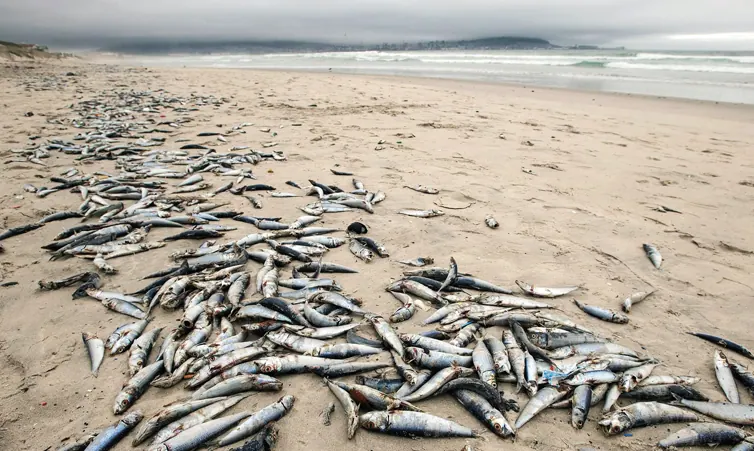
A massive die-off of sardines is currently affecting the coastlines of Namibia and South Africa, with widespread strandings reported along the Western Cape coast of South Africa, stretching from Cape Town to Gqeberha, and in Namibia, from Walvis Bay to Henties Bay. The cause of the die-off is still unclear, but scientists have detected sardine herpesvirus (PHV) in both live and dead fish in South Africa.
While it is uncertain whether PHV is directly causing the deaths or making the fish more vulnerable to environmental stressors, research is underway to determine the link between the events in Namibia and South Africa. The Benguela ecosystem, which spans from South Africa's west coast to southern Angola, may be a factor in the mass die-offs. Namibia's fisheries department is collaborating with its South African counterpart to share samples and investigate a possible connection.
Until more information is available, Namibians are advised not to collect or eat washed-up fish, as they may pose a health risk. This warning is particularly concerning for coastal communities with limited access to food, where the stranded fish could be an important source of nutrition. Some communities are already drying the fish while waiting for test results, despite the risks.
According to Namibia's fishing ministry spokesperson, Romeo Muyunda, the number of dead fish found in Namibia is "not a lot". However, the actual scale of the die-off may be difficult to determine, as strandings may have gone unrecorded along the remote Skeleton Coast or further north in Angola. The impact on the Benguela Current ecosystem is a growing concern, as sardines have already declined sharply due to overfishing.
The decline of sardines could have a serious ecological and economic impact, particularly for African penguins, whose main prey is anchovy and sardine. With only about 1% of their original population remaining, penguins are especially vulnerable to additional shocks. BirdLife South Africa has reported poorer penguin conditions on Dyer Island and at Stony Point, highlighting the potential consequences of the mass die-off.
Previous mass sardine die-offs in Australia in 1995 and 1998 were linked to PHV, resulting in a significant drop in sardine spawning biomass. A similar link has been found in South Africa, with a 99.7% genetic match to the Australian virus. However, the pathway by which the virus reached southern Africa is still unclear, with imported frozen sardines currently considered the most likely route.
In response to the outbreak, a moratorium on the sardine fishery has been debated in South Africa, with authorities restricting catches to 25% of the remaining quota until test results are available. The incident highlights the need for continued monitoring and research into the causes and consequences of mass sardine die-offs, as well as the importance of cooperation between Namibia and South Africa to address the issue.
Key points
- The mass sardine die-off has raised concerns over food safety and ecosystem impact.
- The cause of the die-off is still unclear, but PHV has been detected in affected fish.
- The incident highlights the vulnerability of African penguins and the need for cooperation between Namibia and South Africa.