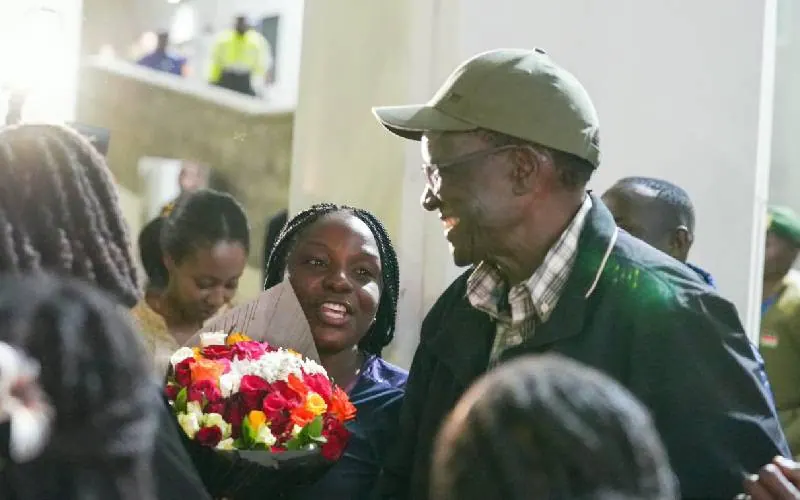
Former Chief Justice David Maraga returned to Kenya from the United States on Tuesday, October 7, 2026, and immediately questioned the government's preparedness to contain the Ebola outbreak. Maraga expressed concerns about the country's ability to detect and contain the disease at its borders, citing the recent case of a patient who contracted and died from Ebola. He demanded urgent action to prevent further infections and ensure the country's healthcare system is equipped to handle the outbreak.
Maraga's concerns were sparked by the government's assurances that the country was prepared to handle Ebola, despite the recent case. He questioned how the patient managed to enter the country, interact with others, and eventually die despite these assurances. Maraga's remarks came hours after Health Cabinet Secretary Aden Duale confirmed the first Ebola case, with one patient having been pronounced dead. The incident has raised fresh questions about the country's preparedness to handle a potentially deadly outbreak.
Maraga linked the Ebola concerns to broader questions over the state of Kenya's healthcare system, saying health services are a constitutional right that should be prioritized by the government. He criticized the government's decision to replace the National Hospital Insurance Fund (NHIF) with new healthcare financing arrangements, arguing that the previous system could have been improved through digitization and by addressing corruption. Maraga claimed that the country had spent Sh104 billion on a system that Kenyans were now being told was not working.
The former Chief Justice also highlighted concerns raised by Kenyans living in the diaspora, particularly over electoral reforms ahead of the 2027 General Election. Maraga said Kenyans living abroad were demanding that the Independent Electoral and Boundaries Commission (IEBC) take voter registration services closer to them, rather than requiring them to travel long distances to designated registration centers. He urged IEBC to establish registration centers in different American states for periods long enough to allow Kenyans to register.
Maraga called for a comprehensive audit and cleaning of the voters' register, warning that the presence of deceased voters on the roll could undermine the credibility of the 2027 election. He also raised concerns over remarks by senior government and ruling party officials that dead voters could participate in elections, saying such statements should not be taken lightly. Maraga emphasized the need for an election that is free, fair, and transparent, with reliable technology capable of transmitting results as required by law.
The ex-CJ also criticized the secrecy surrounding the contract for the Dangote Oil Refinery in Lamu, saying the government should make the deal public if there was nothing sinister about the investment. Maraga's comments came amid renewed efforts by opposition leaders to forge a common political front ahead of the 2027 election. He remained guarded on the question of opposition unity and whether he would support another opposition candidate if he is not picked to run for president.
Maraga concluded by emphasizing the need for electoral reforms to be completed in good time, particularly the cleaning and auditing of the voters' register and ensuring the integrity of election technology. He said opposition leaders are in touch and discussing their next steps, which they will soon share with Kenyans. Maraga's return from the US has sparked renewed debate about the country's preparedness for the 2027 election and the ongoing Ebola outbreak.
Key points
- Former Chief Justice David Maraga questions Kenya's preparedness to contain Ebola outbreak
- Maraga criticizes government's healthcare financing arrangements and electoral reforms
- Maraga calls for comprehensive audit and cleaning of voters' register ahead of 2027 election