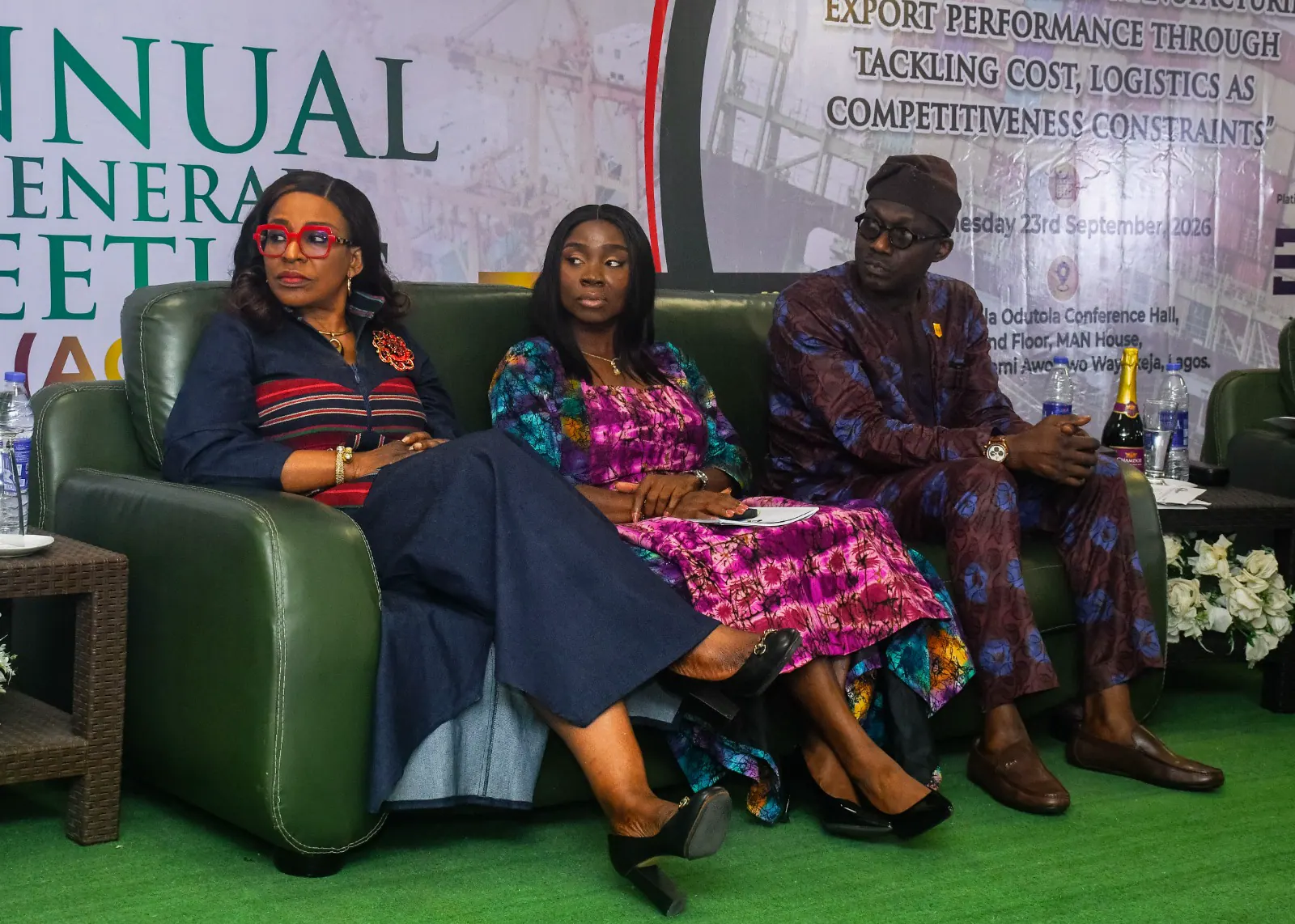
The Manufacturers' Association of Nigeria Export Promotion Group (MANEG) has urged the Federal Government to take coordinated and sustained action to address the high cost of production, logistics bottlenecks and other structural constraints affecting the competitiveness of Nigerian manufactured products in international markets. This call was made at MANEG's 9th Annual General Meeting (AGM) in Lagos, which brought together key stakeholders from government, manufacturing, export promotion and the private sector.
The AGM, themed "Unlocking Nigeria's Manufacturing Export Performance Through Tackling Cost, Logistics as Competitiveness Constraints," aimed to examine the structural barriers limiting Nigeria's ability to translate its manufacturing capacity into stronger export performance and greater participation in regional and global value chains. MANEG Chairman, Mrs. Ruth Owojaiye, noted that the competitiveness of Nigerian exports is significantly affected by the cost of doing business, including high interest rates, unreliable power supply, rising energy and logistics costs, and poor road infrastructure.
Owojaiye emphasized that while manufacturers recognize that structural reforms cannot be achieved overnight, the business community needs to see measurable and sustained progress in addressing the constraints that erode the competitiveness of Nigerian products. She welcomed the recent reduction of the Monetary Policy Rate to 23 per cent but stressed that the ultimate measure of whether monetary policy eases conditions for manufacturers would be its transmission to the real economy through lower financing and production costs.
The MANEG Chairman renewed the Group's call for the settlement of outstanding claims under the Export Expansion Grant (EEG), an important mechanism for supporting exporters operating in a highly competitive global environment. She also stressed the importance of compliance with standards in destination markets, noting that export competitiveness is not only about producing at scale but also about ensuring that Nigerian products meet international standards.
Director-General of the Manufacturers' Association of Nigeria (MAN), Mr. Segun Ajayi-Kadir, noted that Nigeria's high-cost operating environment could undermine the gains from increased market access, including opportunities created by the African Continental Free Trade Area (AfCFTA). He called for greater investment in regional logistics infrastructure, particularly efficient shipping arrangements capable of moving goods between African markets without excessive dependence on road transportation.
Nigerian Export Promotion Council (NEPC) Executive Director and Chief Executive Officer, Mrs. Nonye Ayeni, revealed that Nigeria recorded its highest-ever non-oil export performance in 2025, with export value reaching $6.1 billion and export volume rising to 8.02 million metric tonnes. She highlighted initiatives aimed at reducing the logistics burden on exporters, including domestic export warehouses, the Single Window trade facilitation system and air cargo corridors.
The discussions at the AGM reinforced the need for Nigeria to move beyond viewing exports primarily as a trade issue and embrace manufacturing export competitiveness as a broader economic priority. MANEG's call for closer collaboration among the Federal Government, manufacturers, exporters, financial institutions and relevant regulatory agencies to address cost and logistics constraints confronting businesses underscores the significance of this challenge.
Key points
- MANEG urges government to address high production costs and logistics bottlenecks to boost manufacturing export competitiveness.
- Nigeria's manufacturing export potential is undermined by high interest rates, unreliable power supply, and poor road infrastructure.
- The country recorded its highest-ever non-oil export performance in 2025, with export value reaching $6.1 billion.