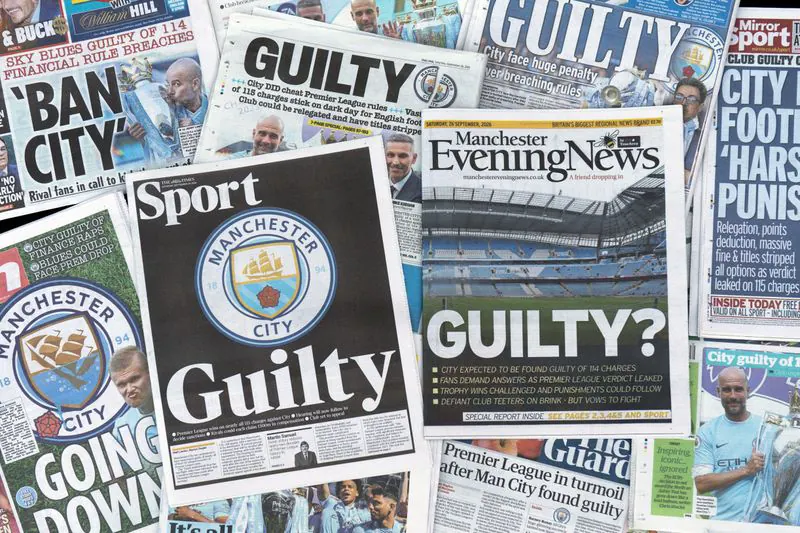
The Manchester City Football Club has been rocked by a scandal involving financial cheating, with the English Premier League finding the club guilty of 114 charges of breaching financial rules. The charges, which date back to the 2009/2010 to 2017/2018 seasons, were brought against the club after revelations from Football Leaks, a series of documents published by German newspaper Der Spiegel in 2018. The leaks exposed how Manchester City had hidden and obfuscated sources of funding to avoid revealing their violations of the league's financial regulations.
The Premier League's investigation into Manchester City's financial dealings found that the club had "cooked their books" to obscure the source and extent of funds used to reach soccer's summit. The club's management was accused of using a "Disguised Funding Scheme", where sponsorship agreements were used to disguise almost £900-million of Abu Dhabi-based shareholder funding as unrelated "commercial partner revenue". This allowed the club to minimise its dependence on its owners and mislead the Premier League into believing that its financial position was better than it truly was.
Manchester City's owner, Sheikh Mansour, is the brother of the United Arab Emirates' president and vice president of the UAE. The club was effectively bought by the Gulf emirate in 2008, and has since used its new owner's funds to accelerate its climb up England and Europe's elite club ladder. The club's historic English and European treble achieved in 2022/2023 has been cast into doubt, given the foundation of misstated funding and expenditure.
The Premier League's Profit and Sustainability Rules, instituted in 2015, govern how clubs are financed, ensuring that a club's spending is directly related to its income from sources independent of its owner's wealth. The rules set an upper limit for a club's financial losses over three years, and are designed to promote fairness and sustainability in the league. Manchester City's breaches of these rules have raised concerns about the integrity of the competition.
The decision to find Manchester City guilty of 114 charges has drawn the ire of fans across England's soccer stadiums and the world's sports bars. The club has a right to appeal against the decision, and any sanctions are yet to be determined. In the meantime, City will continue to compete at the top of the Premier League, despite the finding.
The implications of the scandal go beyond the world of soccer, highlighting concerns about corporate crimes and their impact on the sport. The case has sparked debate about the need for greater transparency and accountability in sports finance, and the role of governing bodies in preventing financial cheating.
As the investigation into Manchester City's financial dealings continues, the soccer world will be watching closely to see how the club responds to the allegations. The case has raised important questions about the relationship between sports and finance, and the need for integrity and fairness in competitions.
Key points
- Manchester City found guilty of 114 charges of breaching Premier League financial rules.
- The club's financial cheating scandal has raised concerns about corporate crimes in sports.
- The Premier League's investigation has highlighted the need for greater transparency and accountability in sports finance.