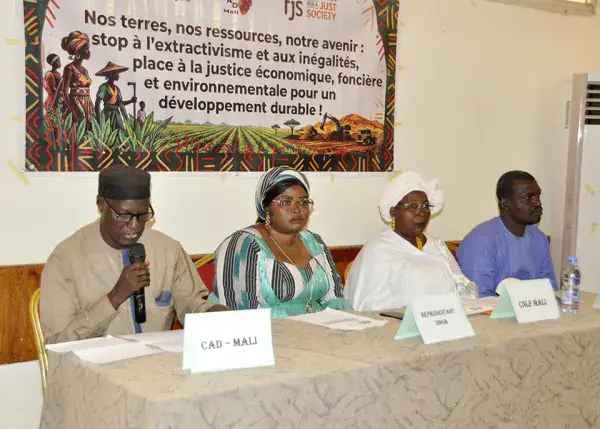
A two-day mobilization event was held in Mali, organized by the Coordination of Feminist Struggles of the Committee for the Abolition of Illegitimate Debts (CADTM-Afrique). The event aimed to bring together various stakeholders to discuss issues related to illegitimate debt, extractive industries, and social justice. Sixty participants from the Bougouni and Dioïla regions attended the event, which was part of the project "Strengthening Eco-Feminist Synergies to Abolish Illegitimate Debt and Build a World Based on Social Justice and Respect for Nature".
The event provided a platform for women to share their experiences and engage in dialogue with decision-makers, financial institutions, local authorities, and extractive companies. Discussions focused on criteria for granting credits, secure access to land, participation in land and mining decisions, and equitable distribution of compensations. The goal was to strengthen the capacity of women to mobilize and advocate for economic, social, environmental, and gender justice.
Bourlaye Bagayoko, Secretary General of CADTM, emphasized the need to prioritize women's concerns in discussions around microcredit and access to financing. He noted that women are often the primary clients of microcredit institutions, but face significant challenges in accessing these services. Bagayoko called for more flexible and adapted financing conditions, as well as reduced interest rates.
Djembéré Alamir, President of the Coalition of African Alternatives to Debt and Development (CAD-Mali), highlighted the obstacles faced by women in accessing microfinance services. These include short loan durations, low amounts granted, restrictive repayment deadlines, and high interest rates. These challenges limit the profitability of women's activities and hinder their economic empowerment.
The event also saw the participation of representatives from various government agencies, including the National Directorate of Geology and Mines. Afouchatou Togora, representing the Directorate, expressed her support for the initiative and emphasized the need for an inclusive document that takes into account the concerns expressed by participants.
The mobilization event adopted a participatory and bottom-up approach, based on the testimonies of women, collective analysis, and dialogue with decision-makers. Participants included women affected by difficulties in accessing microcredit, leaders of rural associations and agricultural cooperatives, as well as activists from areas impacted by extractive activities.
The event concluded with a call to action, emphasizing the need for concrete responses to women's concerns around access to credit, land security, and community participation in natural resource management decisions. For rural women, these issues are crucial to their economic autonomy, livelihoods, and role in local development.
Key points
- The event aimed to strengthen women's capacity to mobilize and advocate for economic, social, environmental, and gender justice.
- Women face significant challenges in accessing microfinance services, including high interest rates and restrictive repayment deadlines.
- The event called for more flexible and adapted financing conditions, as well as reduced interest rates, to support women's economic empowerment.
Reporting sources
- Extractivisme : Les femmes se mobilisent · L'Essor