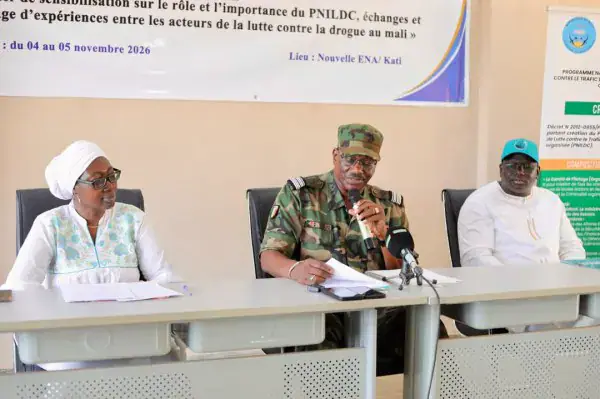
The Malian government has taken a significant step in its fight against drug trafficking and organized crime by hosting a national workshop aimed at strengthening the country's response to these issues. The workshop, which was opened by Colonel-major Dana Sissoko, technical advisor to the Ministry of Justice and Human Rights, brings together various stakeholders to discuss the challenges posed by drug trafficking and organized crime. The two-day event focuses on improving inter-institutional coordination, sharing experiences, and capitalizing on best practices.
According to Colonel-major Dana Sissoko, drug trafficking and organized crime are among the most pressing challenges of our time, affecting nations, weakening institutions, and threatening peace, security, and sustainable development. He emphasized that these phenomena are transnational in nature, making them particularly difficult to combat. Sissoko also highlighted Mali's strategic location in West Africa and the Sahel, which makes it vulnerable to the transit of narcotics, money laundering, and arms trafficking.
The workshop features several modules, including one on the international and sub-regional legal framework for combating drug trafficking. The goal is to promote a coordinated, coherent, and effective response to the problem of drug trafficking and organized crime. The PNILDC, a national program aimed at combating drug trafficking and organized crime, plays a crucial role in this effort, providing a strategic framework for coordinating the efforts of various stakeholders.
The Malian government has made the fight against drug trafficking and organized crime a national priority, adopting a comprehensive approach that includes prevention, repression, institutional capacity building, and national, regional, and international cooperation. The PNILDC is a key component of this approach, enabling the government to mobilize the efforts of different services and promote a coordinated response.
Colonel-major Dana Sissoko emphasized that the fight against drug trafficking and organized crime cannot be left solely to specialized services, but requires the involvement of society as a whole. He stressed the importance of promoting a culture of prevention and awareness, as well as strengthening the capacities of national actors to effectively combat these phenomena.
The workshop provides a platform for stakeholders to share experiences and best practices in combating drug trafficking and organized crime. It also offers an opportunity for participants to discuss the challenges they face and identify areas for improvement in the national response to these issues. By strengthening inter-institutional coordination and cooperation, the Malian government aims to enhance its effectiveness in combating drug trafficking and organized crime.
The fight against drug trafficking and organized crime is a complex and ongoing challenge for Mali and the international community. The country's strategic location in West Africa and the Sahel makes it a critical point in the global fight against these phenomena. By strengthening its national response and promoting international cooperation, Mali is taking a significant step towards addressing the challenges posed by drug trafficking and organized crime.
Key points
- The Malian government has made the fight against drug trafficking and organized crime a national priority.
- The PNILDC plays a crucial role in coordinating the efforts of various stakeholders to combat drug trafficking and organized crime.
- The fight against drug trafficking and organized crime requires the involvement of society as a whole.