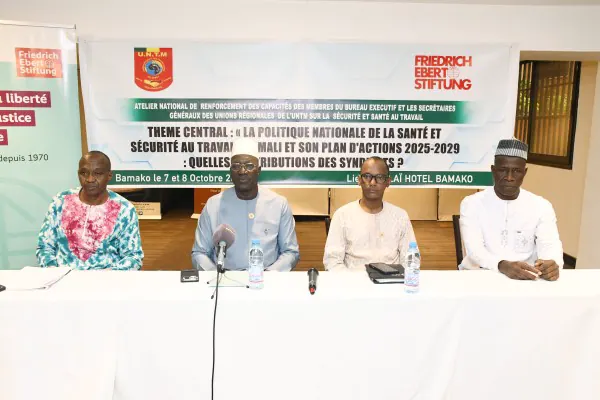
The Union nationale des travailleurs du Mali (UNTM) recently launched a two-day workshop aimed at enhancing the knowledge of its members on health and safety at work. The event, which took place at a hotel in Bamako, brought together members of the union's executive bureau and regional secretaries. The workshop's primary objective is to equip participants with the necessary skills to effectively address health and safety concerns in the workplace.
The ceremony was attended by Yacouba Katilé, the Secretary-General of UNTM, and Amadou Samaké, representing the Friedrich Ebert Stiftung Foundation. Katilé emphasized that the current mandate prioritizes capacity building on national and international texts. He noted that the workshop would enable union leaders to familiarize themselves with the National Health and Safety Policy and its action plan (2025-2029), adopted in September 2025.
The workshop covers various topics, including concepts, challenges, and the general situation in Mali regarding health and safety at work. Participants will also discuss the normative and institutional framework of health and safety, focusing on International Labor Organization (ILO) conventions 155 and 187. Additionally, they will explore the National Health and Safety Policy and its action plan, as well as the role of social dialogue in implementing innovations in the General Status of Civil Servants and labor code amendments.
According to Katilé, the union's role is crucial in promoting a culture of prevention, awareness-raising, and collective bargaining. He stressed that health and safety at work is a fundamental right and a cornerstone of decent work. The Secretary-General also highlighted the urgency of this issue in Mali, given the country's work environment, high professional risks, and inadequate prevention culture.
Amadou Samaké, representing the Friedrich Ebert Stiftung Foundation, welcomed the workshop's theme, emphasizing the importance of protecting workers from occupational hazards. He noted that in the event of an accident, knowledge of health and safety texts would facilitate better support for victims in terms of compensation. Samaké also underscored the significance of worker participation in identifying professional risks and proposing solutions.
The workshop aims to enable participants to analyze challenges and develop concrete action plans, including a union roadmap. Katilé emphasized that without appropriation by social actors, the National Health and Safety Policy, despite its relevance, risks limited effectiveness. The Secretary-General expressed gratitude to the Friedrich Ebert Stiftung Foundation for its support in organizing the workshop.
The training is part of UNTM's ongoing efforts to enhance its members' capacities through education and training programs. By strengthening its members' knowledge and skills, the union seeks to promote improved working conditions and protect workers' rights in Mali. The workshop's outcomes are expected to contribute to a safer and healthier work environment for Malians.
Key points
- UNTM holds a two-day workshop to educate members on workplace health and safety in Mali.