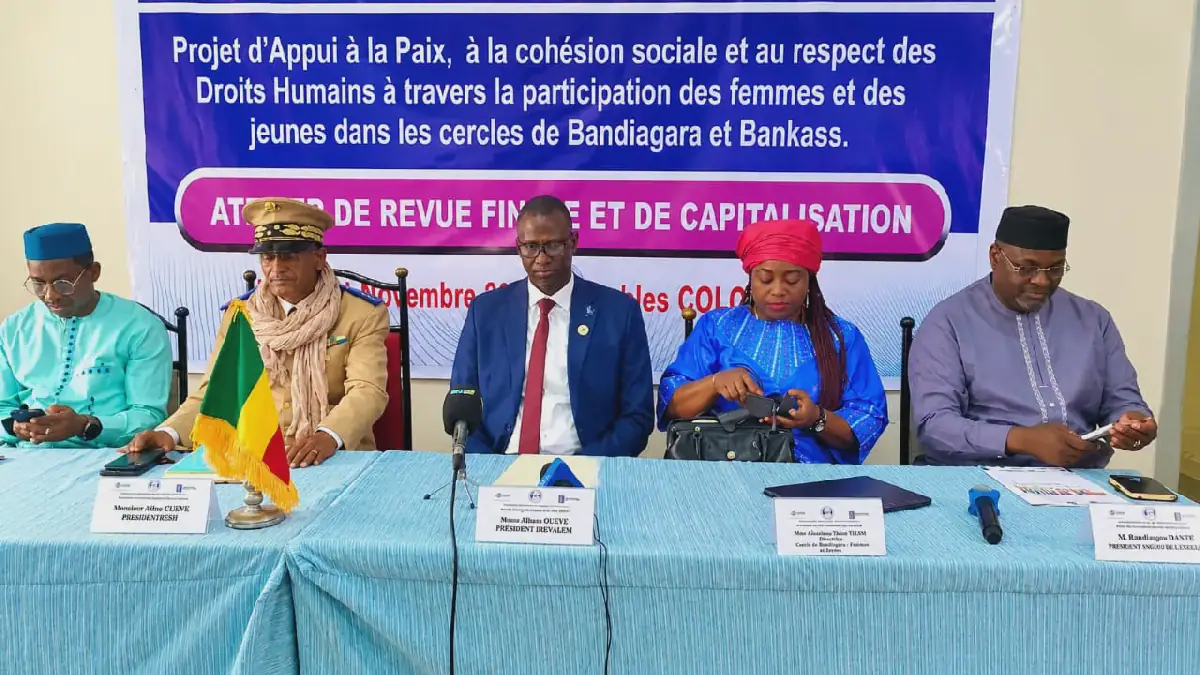
The RENAJEM organization recently concluded a 12-month peace project in eight villages across Bandiagara and Bankass in Mali. The initiative, titled "Support for Peace, Social Cohesion, and Respect for Human Rights through Women's and Youth Participation," received 80 million FCFA in funding from Denmark through the second phase of the Fund for Support to Change Drivers (FAMOC II). The project aimed to promote peace and social cohesion in the region.
Key accomplishments of the project include the establishment of two concertation frameworks, eight monitoring groups, and the training of 60 peer educators and approximately 220 young people and women in conflict prevention. The project also organized over 236 awareness-raising sessions, reaching more than 8,000 individuals, and held a national forum in Bandiagara. These efforts were geared towards promoting peace, social cohesion, and respect for human rights.
The project's closing workshop, held at the Les Colonnes de Bamako hotel, brought together members of the National Transition Council (CNT) and ministerial representatives. RENAJEM President Alioune Gueye praised the mobilization of local actors in difficult-to-reach areas and emphasized the need for a second phase focused on empowering young people and women. He noted that precarious living conditions often fuel tensions in the region.
Agathe Kéméalo Télou, head of the Gender and Youth Unit at UNOWAS, echoed Gueye's sentiments, citing UN resolutions 1325 and 2250. She stressed that women and young people should be recognized as strategic actors in peacebuilding, rather than mere beneficiaries. Télou's remarks underscored the importance of involving women and youth in peace initiatives.
The project's impact was acknowledged by various stakeholders, including Bandiougou Danté, president of the Maison de la presse. He encouraged the media to amplify the project's achievements through responsible journalism, countering hate speech. The representative of FAMOC II also called for sincere capitalization to ensure the sustainability of the observed changes.
In his opening remarks, Colonel Sédik Baba Ould, prefect of Kani, invited communities to sustain the project's gains and advocated for the extension of similar initiatives to the entire region. The project's success was seen as a crucial step towards promoting peace and social cohesion in Mali.
The RENAJEM project's achievements demonstrate the potential for grassroots initiatives to promote peace and social cohesion in conflict-prone regions. As the project comes to a close, stakeholders are looking towards the future, with hopes that the gains made will be sustained and built upon.
Key points
- The project trained 60 peer educators and approximately 220 young people and women in conflict prevention.
- Over 236 awareness-raising sessions were organized, reaching more than 8,000 individuals.
- The project's second phase is expected to focus on empowering young people and women.