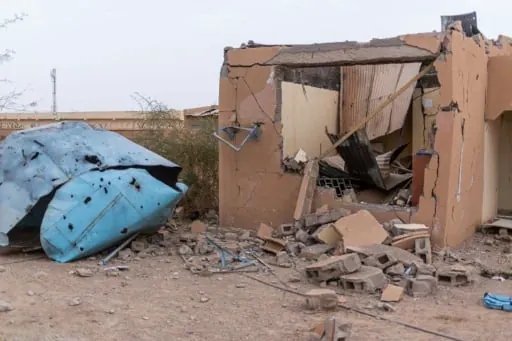
Mali's armed forces, backed by Russian paramilitaries, have recaptured the strategic northern city of Kidal, a highly symbolic success five months after losing control to separatists. The city, a historic rebel stronghold, was reclaimed without a fight after the Azawad Liberation Front (FLA) announced a "strategic and controlled withdrawal" of its forces. The recapture of Kidal is seen as a boost to Mali's junta, which has been struggling to control territory in the vast desert nation plagued by jihadist insurgency and Tuareg separatist demands.
The FLA's withdrawal from Kidal was attributed to a desire to "preserve human lives," with the group specifying that the measure was "temporary." The Malian army's success in retaking Kidal shows it is regaining standing against the Group for the Support of Islam and Muslims (JNIM), a jihadist group linked to Al-Qaeda. JNIM has imposed a blockade on the capital and carried out numerous large-scale attacks across the country, including a major attack on the Dioura military camp in central Mali in September that killed at least 100 Malian soldiers.
According to Jean-Herve Jezequel, Sahel project director at the International Crisis Group (ICG), the recapture of Kidal "changes nothing regarding the balance of power." He emphasized the "symbolic" nature of the success, noting that it "helps fuel the idea that the regime is not as down-and-out as some have claimed." Hasret Kargin, a researcher specializing in the Sahel, said that while the loss of Kidal is a setback for the FLA, it does not imply that they will be eliminated.
Kidal has changed hands several times in recent years, with rebel groups controlling the city for nearly a decade before it returned to Malian state authority in November 2023. The city's strategic importance lies in its location in the north, a region where Mali's government has struggled to maintain control. The Malian army's recapture of Kidal is seen as a significant achievement, particularly given the group's ability to enter the city without encountering resistance.
Algeria, which has long been at odds with Bamako, may have played a role in the retaking of Kidal. According to sources, Algiers reportedly asked the rebels not to resist, allowing it to position itself as a mediator. A regional security source told AFP that "reports indeed indicate that Algiers encouraged the rebels not to fight." However, it remains to be seen how Algiers will balance its relations with both the rebels and Bamako.
Despite the recapture of Kidal, Mali's central government continues to struggle with maintaining control over its vast territory. The government retains a foothold in cities, including Gao, Timbuktu, and Kidal, but many rural areas are under jihadist control. More than 2,000 schools in the country's center have been forced to close, and the army has abandoned certain camps. According to Jezequel, "what the Malian state and its partners control are the cities. As for the rest, the countryside, the state merely passes through."
The recapture of Kidal is a significant development in Mali's ongoing conflict, but its impact remains to be seen. The country's junta will likely welcome the symbolic victory, but the challenges of maintaining control over the country's vast territory remain substantial. The role of Algeria in the retaking of Kidal adds a new layer of complexity to the conflict, and it remains to be seen how the situation will evolve in the coming months.
Key points
- Mali's recapture of Kidal is a symbolic success that boosts the junta's standing.
- The city's recapture does not significantly change the balance of power in the region.
- Algeria may have played a role in the retaking of Kidal, encouraging rebels not to resist.