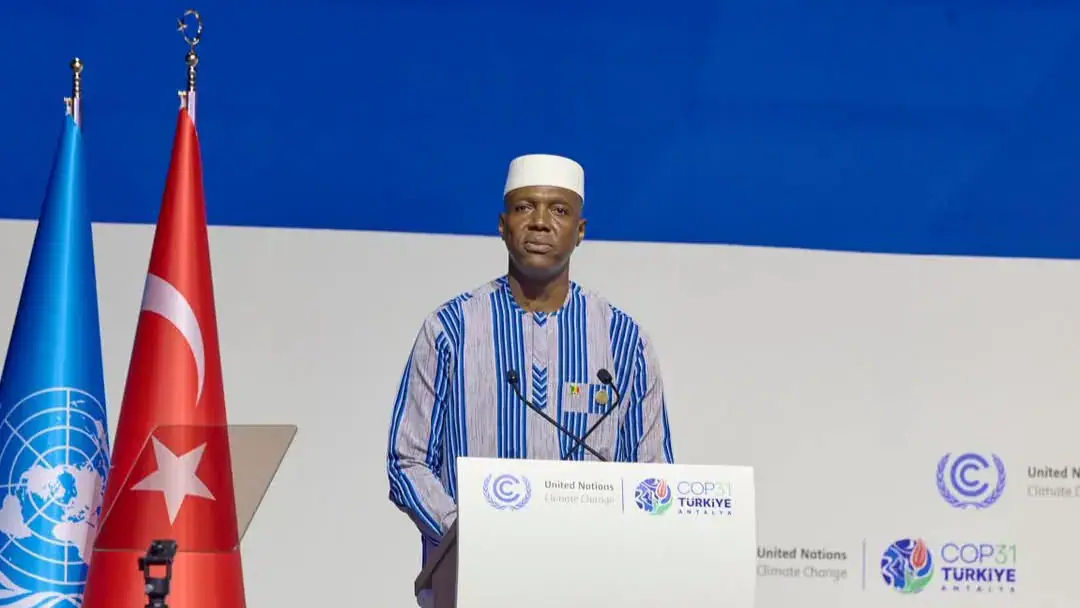
Mali's Prime Minister, General Abdoulaye Maïga, delivered a speech at the 31st Conference of Parties to the United Nations Framework Convention on Climate Change, COP31, in Antalya, Turkey. He expressed gratitude to the Turkish authorities and the city of Antalya for their warm welcome and hospitality. Maïga also acknowledged the joint commitment of Turkey and Australia to co-preside over COP31.
Maïga highlighted the challenges faced by Mali and its allies in the Sahel region, including landlockedness, desertification, and land degradation. These environmental issues affect the livelihoods of the population and exacerbate the security situation. The Alliance of Sahel States (AES) is working to eradicate terrorism, which is sponsored by external supporters. Maïga emphasized the need for collective action to address these pressing issues.
The Malian government has adopted a vision for 2063, known as "Mali Kura Ɲɛtaasira ka bɛn san 2063 ma," which aims to build a new, sovereign, prosperous, and sustainable Mali. As part of this vision, the government has launched the "Yelen Kura" program, which integrates a prospective plan from 2024 to 2063. This program includes the installation of 4,142 MWc of solar power, which is expected to reduce CO2 emissions by 132 million tons.
Maïga also discussed Mali's efforts to restore degraded lands and rehabilitate the Niger and Senegal rivers. The country's third Nationally Determined Contribution (CDN 3.0), validated on October 1, 2026, aims to reduce greenhouse gas emissions by 25.25% by 2035. This commitment demonstrates Mali's dedication to addressing climate change, despite the challenges it faces.
The Prime Minister called on polluting countries to acknowledge their historical responsibility, honor their commitments, and accelerate emission reductions. He emphasized the need for climate justice and reform of the international financial architecture. Maïga also expressed Mali's willingness to cooperate with international partners while respecting its sovereignty and strategic choices.
In addition to its climate change efforts, the Malian government has implemented various initiatives to improve the lives of its citizens. For example, President Assimi GOITA has overseen the drilling of 564 wells in five years as part of his social projects. The government has also developed a National Climate Security Strategy and an Action Plan.
The Declaration of Bamako was adopted in November 2023, following the first Regional Forum on Climate Security in the Sahel. This declaration highlights the need for collective action to address climate-related security challenges. Mali's participation in COP31 demonstrates its commitment to finding solutions to the pressing issues of climate change and its impacts on the Sahel region.
Key points
- Mali aims to reduce greenhouse gas emissions by 25.25% by 2035.
- The country plans to install 4,142 MWc of solar power to reduce CO2 emissions.
- Mali calls for climate justice and reform of the international financial architecture.