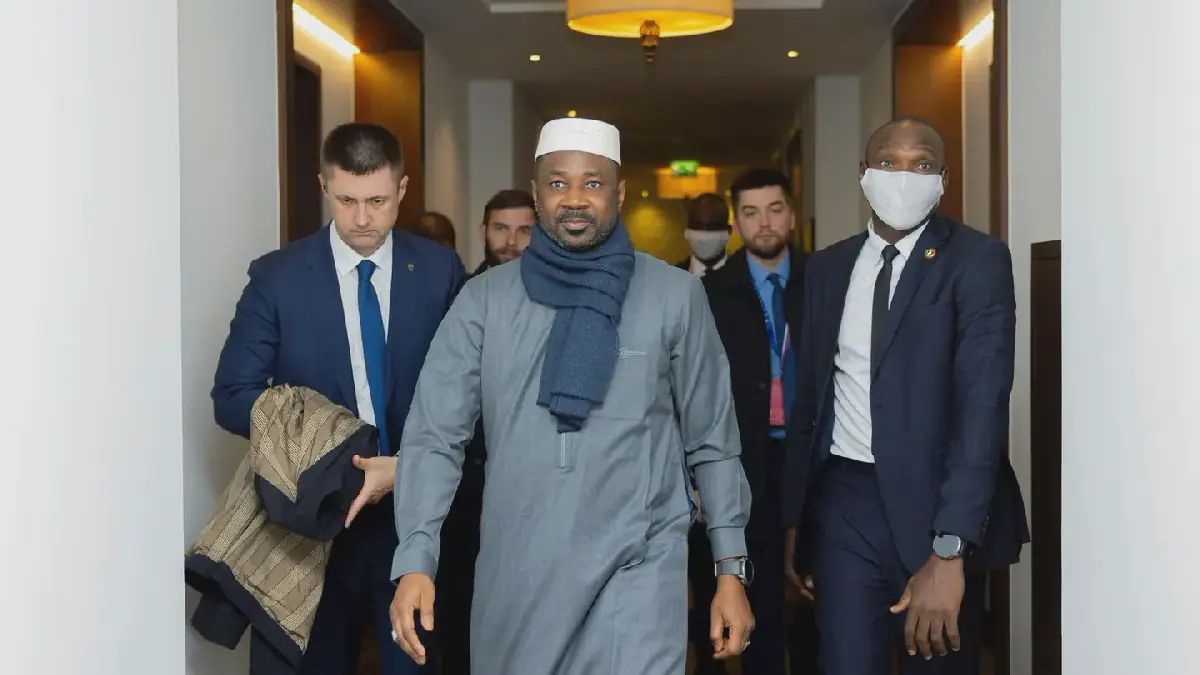
The 3rd Russia-Africa Summit took place in Moscow, Russia, on October 28-29, 2026. Mali's President of the Transition, General Assimi Goïta, led a high-level delegation to the event, which included several members of his cabinet and government officials. The summit provided a platform for African leaders to engage with Russian President Vladimir Putin and discuss ways to enhance cooperation between Russia and Africa. President Goïta's participation marked his second appearance at the summit, following the previous edition in Saint-Petersburg.
During his address at the summit, President Goïta outlined Mali's strategy to combat terrorism, emphasizing the need for the country to rely on its own capabilities to ensure its security and defense. He noted that despite over a decade of fighting terrorism, the presence of international forces has not yielded desired results. As a result, the Malian people have opted for a new approach, focusing on self-reliance and national sovereignty. This shift in strategy has led to a significant improvement in the capabilities of the Malian Armed Forces (FAMa).
President Goïta also highlighted Mali's commitment to its national vision, Mali-2063, which aims to drive institutional, economic, and social reforms. He emphasized that the country's new constitution is based on three core principles: respect for state sovereignty, the sovereign choice of the people, and the defense of national interests. The President praised President Putin's leadership, which has enabled Russia to become a key player in global geopolitics. He expressed Mali's interest in exploring new opportunities for cooperation with Russia, based on mutual respect, sovereignty, and equality.
The summit provided a platform for President Goïta to engage with other African leaders and discuss pressing issues facing the continent. He noted that Africa is rich in opportunities and should not become a space for competition between global powers or a mere supplier of raw materials. Instead, Africans should be full-fledged actors in global governance, capable of determining their priorities, protecting their interests, and choosing their partners freely. Mali's participation in the summit was aimed at exploiting its sovereignty while promoting mutually beneficial partnerships.
The Malian delegation's participation in the summit yielded tangible results, including the signing of two geological agreements. Additionally, several major partnerships were discussed, including the Sénou Gold Refinery project, the Sanankoroba solar power plant, and a contract with KAMAZ-SMTL-SA for the supply of 350 trucks. These agreements are expected to strengthen economic ties between Mali and Russia, with a focus on mutually beneficial cooperation.
President Goïta's speech also touched on the changing global landscape, characterized by a shift towards a multipolar world and a growing desire for nations to assert their autonomy. He expressed Mali's commitment to a just and equitable international order, based on the principles of sovereignty, non-interference, and respect for international law. The President emphasized that Mali's participation in the summit was a demonstration of its commitment to constructive engagement with the international community.
The 3rd Russia-Africa Summit concluded with a renewed commitment to strengthen ties between Russia and Africa. Mali's participation in the summit was deemed honorable, reflecting the country's efforts to assert its sovereignty and explore new opportunities for cooperation. The event provided a platform for African leaders to engage with Russian President Putin and discuss ways to enhance cooperation between Russia and Africa.
Key points
- Mali's President Assimi Goïta leads a high-level delegation to the 3rd Russia-Africa Summit in Moscow.
- President Goïta outlines Mali's strategy to combat terrorism, emphasizing self-reliance and national sovereignty.
- The summit yields tangible results, including the signing of two geological agreements and discussions on major partnerships.