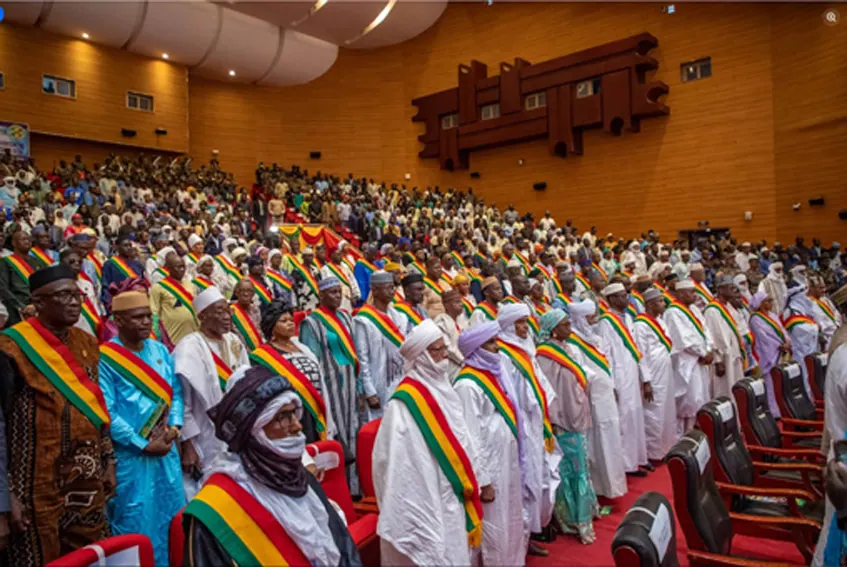
The National Transition Council (CNT) of Mali has commenced its October session, which will run for a maximum of 75 days. The session, opened on October 5, 2026, at the Bamako International Conference Centre (CICB), will be dominated by the examination of the 2027 finance bill. According to the CNT's President, Malick Diaw, the council will also study over 30 projects of law and revisit five organic laws.
The legislative agenda for the session includes a range of texts that were deferred during previous sessions, as well as new projects submitted by the Government. Five organic laws related to the Constitutional Court, Supreme Court, Court of Auditors, Higher Council of the Judiciary, and national languages will also be re-examined. These laws were previously reviewed by the Constitutional Court and are now being reconsidered by the CNT in light of the court's observations.
In addition to these texts, the Government has adopted several ordinances during the intersession period, including a project modifying the Code of Persons and Family, which deals with the loss and deprivation of Malian nationality. Other ordinances concern the status of villages, fractions, and neighborhoods, as well as the fiscal resources of local authorities, adapted to the new administrative organization.
The 2027 budget is a key item on the agenda, with the finance bill adopted by the Council of Ministers on September 18. The bill projects 3,866.635 billion CFA francs in revenue and 4,462.646 billion in expenditure, resulting in a deficit of 596.011 billion. Compared to the 2026 rectified finance law, revenue is expected to increase by 14.64%, expenditure by 11.75%, and the deficit to decrease by 3.93%.
The examination of the budget will build on the Budgetary Orientation Debate held in June, which focused on the 2027-2029 Multi-Year Budgetary and Economic Programming Document. Malick Diaw emphasized that the council's role is to verify that the financial priorities announced are being implemented and that growth and revenue mobilization assumptions are being met.
The session will also focus on monitoring the Government's action, with council members scrutinizing the credits requested for 2027, the execution of ongoing programs, and the results achieved. Government ministers will be questioned in their respective areas before the Finance Commission synthesizes the information and a plenary debate takes place.
Furthermore, the CNT will follow up on the recommendations of the inaugural session of the Parliaments of the Sahel States Confederation, held in Niamey from August 24 to 29. These recommendations were transmitted to the Heads of State of the Alliance of Sahel States. The council's decisions will be crucial in balancing institutional reforms, budgetary constraints, and social expectations.
Key points
- The CNT will examine the 2027 finance bill, which projects a revenue increase of 14.64% and an expenditure increase of 11.75%.
- Over 30 projects of law and five organic laws will be studied during the session.
- The council will also monitor the Government's action and follow up on the recommendations of the Sahel States Confederation.