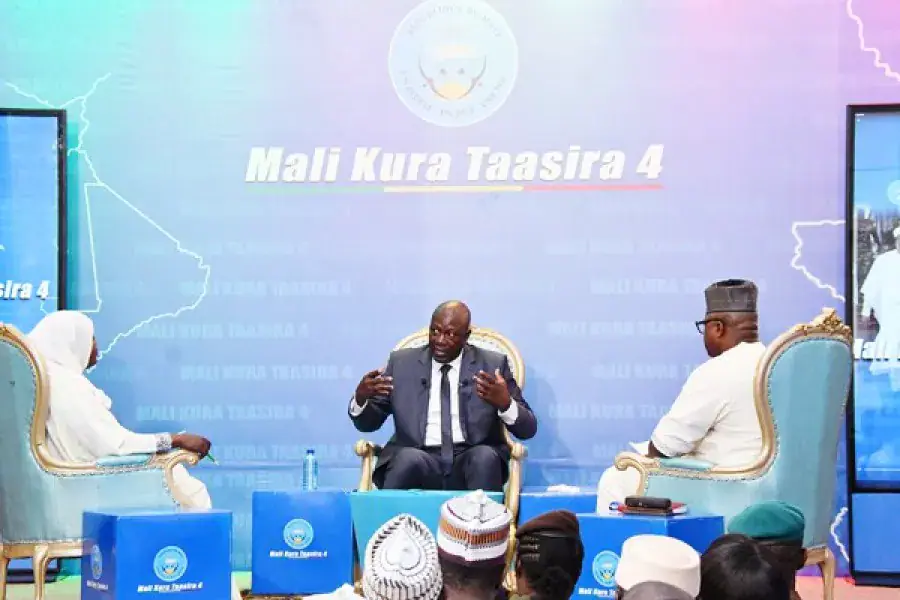
The Malian government's program, Mali Kura Taasira 4, recently hosted a meeting where Dr. Mahamadou Koné, Minister of Religious Affairs, Culte, and Customs, presented the achievements of his department over the past five years. The program aims to promote transparency and accountability in the government's actions. Dr. Koné highlighted the ministry's role in fostering cohesion among Mali's diverse communities and promoting peaceful coexistence.
Dr. Koné emphasized the importance of dialogue between different faith communities, citing 18 meetings held with various religious groups and associations over the past five years. These meetings have helped strengthen relationships between the ministry and religious leaders, promoting interfaith dialogue and preventing conflicts. The minister also noted that these efforts have supported initiatives for peace and national unity.
The organization of pilgrimages, particularly the Hajj, has been another key area of focus for the ministry. Dr. Koné reported that several measures have been taken to improve the experience for pilgrims, including revising legislative and regulatory texts governing the Hajj, establishing a digital platform for managing quotas, and enhancing training and supervision for pilgrims. These reforms aim to increase transparency and quality in the organization of the pilgrimage.
The minister also discussed efforts to support Christian pilgrims, ensuring their safe passage and well-being during religious travels within Mali and abroad. His department plans to develop specific texts to better regulate these religious trips, respecting each faith community's traditions. Additionally, Dr. Koné mentioned his support for pilgrimages in Kita, demonstrating the government's commitment to accommodating diverse religious communities.
In the area of religious education and professional development, Dr. Koné highlighted a collaboration with the Kingdom of Morocco, which provided training for 700 imams and female preachers in Islamic sciences and various professional skills such as plumbing, electricity, and tailoring. This initiative combines religious knowledge with practical skills, enhancing the employability and social contributions of these individuals.
The ministry has also been actively engaged in preventing violent extremism and terrorism. Dr. Koné reported that 35 intercommunity and interfaith dialogue sessions were organized, and 1,326 religious leaders, women, and young people received training on preventing violent extremism, community mediation, and deradicalization techniques. Furthermore, four deradicalization centers were built and equipped in Mopti, Gao, Segou, and San regions.
Looking ahead, Dr. Koné outlined several priorities for his department, including the adoption of texts related to religious freedom, enhancing the training of religious leaders, improving Hajj organization, and regulating Christian pilgrimages. The issue of religious marriage is also on the agenda, with the goal of continuing to structure the sector, consolidating achievements, and closely monitoring ongoing actions.
Key points
- Dr. Mahamadou Koné's efforts focus on promoting interfaith dialogue, preventing conflicts, and enhancing pilgrimage experiences for Mali's diverse religious communities.
Reporting sources
- Mali Kura Taasira 4 : Le ministre Mahamadou... · Maliweb.net