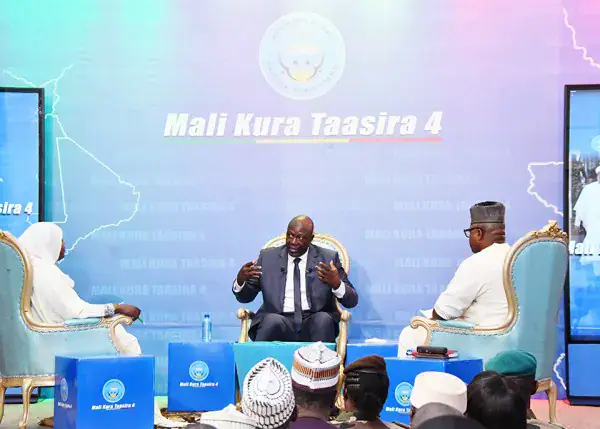
Dr. Mahamadou Koné, Mali's Minister of Religious Affairs, Cult, and Customs, recently presented the achievements and future prospects of his department on the national television program, Mali Kura Taasira 4. The program aims to promote dialogue between government members and the national press. During his appearance, Dr. Koné emphasized the importance of inter-religious dialogue, improved pilgrimage organization, and prevention of violent extremism as key areas of focus for his ministry.
Over the past five years, Dr. Koné's department has organized 18 consultation meetings with various religious confessions and associations. These meetings have strengthened relations between the ministry and religious actors, fostered inter-religious dialogue, and helped prevent conflicts. The minister highlighted that these initiatives have also supported peace and national unity efforts. Furthermore, Dr. Koné's department has prioritized pilgrimage organization, particularly the Hadj, introducing measures to improve conditions for participants.
To enhance the pilgrimage experience, Mali's Ministry of Religious Affairs has revised legislative and regulatory texts governing the Maison du Hadj, established a digital platform for quota management, and improved training and supervision for pilgrims. Dr. Koné emphasized that these reforms aim to increase transparency, accountability, and service quality in organizing the pilgrimage to Mecca. Additionally, the ministry has provided support for Christian pilgrimages, both within Mali and abroad.
The ministry has also focused on training and capacity-building for religious leaders. In collaboration with the Kingdom of Morocco, 700 imams and female preachers have received training in Islamic sciences and various professional skills, such as plumbing, electricity, and tailoring. This initiative seeks to combine religious knowledge with practical skills. Moreover, the ministry has conducted 35 inter-community and inter-religious dialogue sessions, trained 1,326 leaders in preventing violent extremism, and established four deradicalization centers.
Dr. Koné's department has made significant strides in promoting social cohesion and preventing extremism. The minister highlighted that his ministry's role is crucial in fostering national unity and social cohesion. By engaging with various religious communities, the ministry aims to create an environment conducive to peaceful coexistence. Furthermore, Dr. Koné emphasized the importance of addressing emerging challenges, including the adoption of texts related to religious freedom and the strengthening of religious leader training.
Looking ahead, Dr. Koné's ministry is set to tackle several key priorities, including improving Hajj organization, enhancing Christian pilgrimage supervision, and addressing the issue of religious marriage. The ministry aims to consolidate its achievements, reinforce action, and ensure effective monitoring of its initiatives. By pursuing these objectives, Dr. Koné's department seeks to promote a more harmonious and cohesive society.
Ultimately, Dr. Mahamadou Koné's efforts as Minister of Religious Affairs reflect Mali's commitment to inter-religious dialogue, social cohesion, and peaceful development. Through his department's initiatives, the minister aims to create a more inclusive and tolerant environment, where diverse religious communities can coexist and contribute to the country's growth.
Key points
- Dr. Mahamadou Koné's ministry has organized 18 consultation meetings with various religious confessions and associations to foster inter-religious dialogue and prevent conflicts.