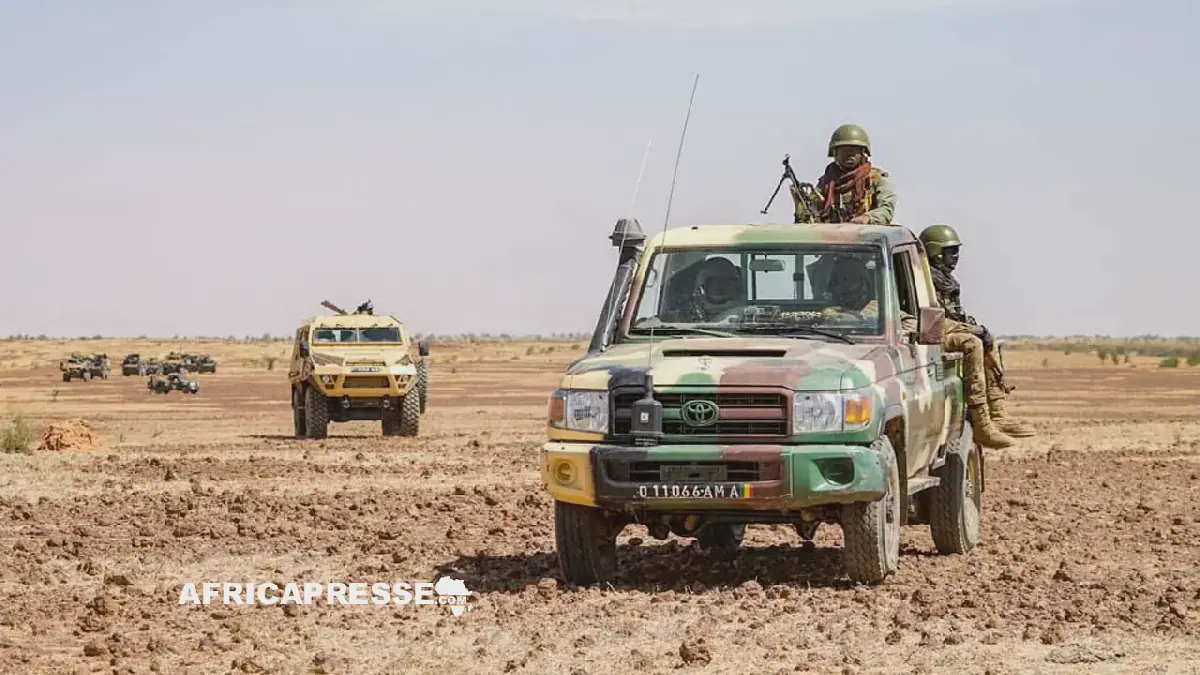
The Malian military has announced that it has neutralized 4,880 combatants from armed groups and destroyed 162 bases between May and October 20. According to the Directorate of Information and Public Relations of the Armed Forces (DIRPA), the operations also resulted in the destruction of 315 pick-up vehicles and approximately 1,300 motorcycles. These operations were part of the "Dougoukoloko" operation, which covered nearly six months of military activities.
The military operation was conducted on three fronts, with the eastern region being a key focus area. The regions of Gao, Ménaka, and Kidal, as well as several strategic axes in the north, were targeted. The DIRPA highlighted the return of Malian forces to Kidal, which was achieved after an offensive launched on October 6, as a significant accomplishment during this period. A mission led by the Chief of General Staff of the Armed Forces on October 10 and 11 assessed the conditions for a gradual return of populations, administration, and basic social services to the area.
In the central region, specifically in Ségou, San, Mopti, Bandiagara, Douentza, Tombouctou, and Taoudéni, the military reported over 200 combatants neutralized and ten vehicles and 95 motorcycles destroyed in recent operations. The southern region saw interventions targeting forested areas and massifs used as refuges by armed groups. These numbers build upon previous communications from the DIRPA, which reported 1,850 combatants neutralized between June and July, and approximately 1,000 in August.
The recent military operations and claims of neutralizing combatants come amid a significant reconfiguration of the security landscape in Mali. The country has seen the withdrawal of the Barkhane force and the United Nations Multidimensional Integrated Stabilization Mission in Mali (MINUSMA), which was completed in December 2023. The Alliance of Sahel States (AES), comprising Mali, Burkina Faso, and Niger, is also rising to prominence. The recapture of Kidal, a historical stronghold of independent armed groups, is a major symbolic and strategic issue for the junta that has been in power since 2021.
The Malian military aims to consolidate its presence in Kidal and secure supply corridors sustainably. The air force has conducted 1,887 surveillance and monitoring missions between May and September, accompanied by 791 strikes, with an additional 65 strikes carried out between October 1 and 20. These efforts demonstrate an increase in air power but raise questions about the effective control of recaptured areas over time. The return of populations and administration to Kidal depends on the sustainability of security in a region where armed groups retain harassment and mobility capabilities.
The military is also focused on reinforcing the ranks of the Malian Armed Forces (FAMa) by integrating new non-commissioned officers, recruits, and young people from the National Youth Service. This effort aims to compensate for the departure of international forces. Securing road axes and transporting essential products is central to the operational plan. In September, 2,556 tanker trucks were escorted on the Kadiana-Bamako axis to ensure the continuity of fuel supplies to the capital.
The military's escort operations, which guarantee the logistical continuity, also reveal the persistent fragility of territorial control and the increasing operational cost supported by the army to maintain vital circuits. The DIRPA's reports, while indicating an intensification of operations, are official communications that few independent observers can verify on the ground due to restricted access to conflict zones. The credibility of these reports will depend on the authorities' ability to document results, secure recaptured areas sustainably, and allow the effective return of displaced populations.
Key points
- The Malian military claims to have neutralized 4,880 combatants and destroyed 162 bases in recent operations against armed groups.
- The operations were conducted on three fronts, with a focus on the eastern region, including the regions of Gao, Ménaka, and Kidal.
- The military aims to consolidate its presence in Kidal and secure supply corridors sustainably.