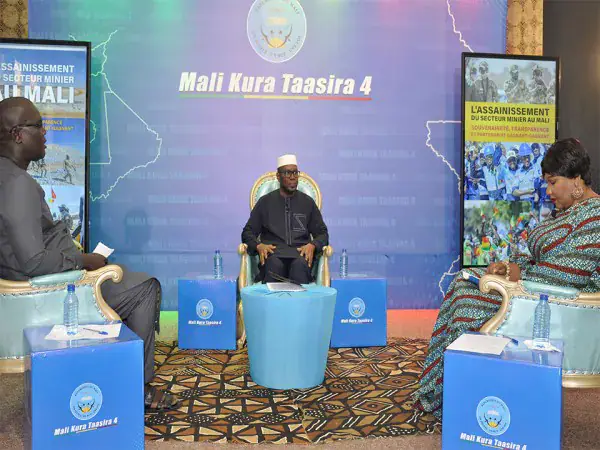
Mali's Minister of Mines, Pr Amadou Keïta, recently discussed the country's mining sector and its challenges on the government information campaign show "Mali Kura Taasira". The minister highlighted the need to better organize the artisanal gold mining sector, which has seen a surge in the number of Malian nationals returning from Guinea. These individuals were previously engaged in clandestine gold exploitation in Guinea but have now returned to Mali.
The Malian government has implemented measures to sanitize the mining sector, strengthen controls, and improve the sector's contribution to the national economy. One of the key actions has been to withdraw permits from companies that have violated mining, customs, environmental, and social regulations. In 2022, audits and controls led to the revocation of three exploitation permits due to serious breaches. The government aims to ensure that mining activities benefit local populations and that revenues are distributed fairly.
The redistribution of mining revenues is another critical issue for the Malian government. The Fonds minier de développement local (FMDL) was established to allow local communities to benefit from mining activities. In 2025, the FMDL mobilized 18.4 billion Fcfa, which will be distributed among communes directly impacted by mining activities, other communes in mining zones, and those in other regions. The goal is to ensure transparent management and rigorous monitoring of these funds to translate them into concrete projects that benefit local populations.
The mining sector's governance is also being strengthened through institutional reforms. New structures have been created, including the Commissariat chargé des activités minières, the Brigade spéciale des mines, the Office malien des substances minérales, and the Société de patrimoine minier du Mali. These entities aim to improve control over mining activities, knowledge of mineral resources, and the state's participation in valorizing the national mining heritage. Digitalization is also a key aspect of modernization, with the Système d'information du cadastre minier (SICAM) having been operational for eight months.
The mining sector's production levels were also discussed, with gold industrial production reaching 42.2 tonnes in 2025, down from 54.8 tonnes in 2024. However, gold exports generated 2,750 billion Fcfa in 2025, up from 1,610 billion Fcfa the previous year. Payments from mining companies to the state totaled 888.5 billion Fcfa, a 6.4% increase. The lithium sector also shows promise, with the two operating mines producing 440,286 tonnes of spodumène in 2025, valued at over 138 billion Fcfa.
The government aims to transform financing into concrete achievements, such as infrastructure, collective equipment, and projects that meet local needs. To achieve this, the minister emphasized the importance of transparent management and rigorous monitoring of resource utilization. The creation of new structures, such as the École des mines et du pétrole, is also expected to enhance national skills and expertise in the mining sector.
Looking ahead, the Malian government is focused on reinforcing public control, improving economic returns, and promoting local valorization of resources. Discussions are underway regarding local transformation of minerals and the production of components for energy storage. With these efforts, the government aims to make the mining sector a key driver of Mali's economic growth and development.
Key points
- Mali's gold exports reached 2,750 billion Fcfa in 2025.
- The country's mining sector is being strengthened through institutional reforms and digitalization.
- Lithium production is also on the rise, with 440,286 tonnes of spodumène produced in 2025.